
Plant Encyclopedia

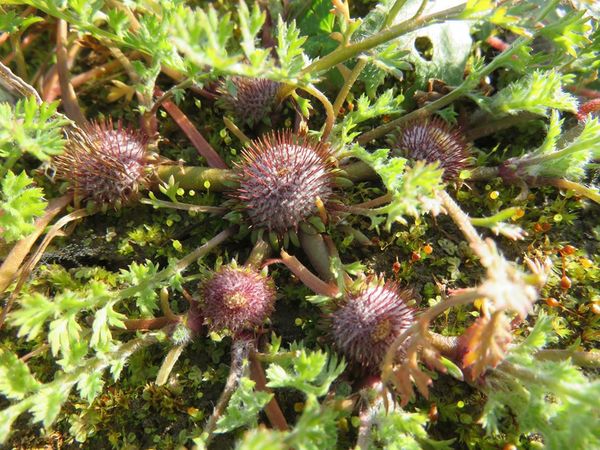
Soliva anthemifolia (button burrweed, "Igatokinso")
Japanese name: イガトキンソウ
Scientific name: Soliva anthemifolia
[Overview]
An annual 5–10 cm tall, growing on roadsides and similar places.
The stems creep along the ground and are very short or almost absent.
The leaves are alternate, rise up in clusters, and are oblong, 5–15 cm long, deeply pinnately divided 2–3 times, with sparse soft hairs on both surfaces.
The leaves usually have 7–11 lobes, and the final lobes are about 0.1 cm wide with pointed tips.
Yellow-green flower heads 0.5–1.2 cm across are borne at the center of the plant, touching the ground; they have no stalks and often produce roots from the base.
Each flower head has many female flowers on the outside and 8–12 bisexual flowers in the center.
The female flowers have no corolla and only a style, while the bisexual flowers have a yellow corolla with a 3-lobed tip.
The involucre is spherical, the involucral bracts are membranous and arranged in one row, and the involucre is surrounded by the bases of the leaf stalks.
The fruit is an achene 0.2 cm long, oblanceolate to obovate, longer than it is wide.
The achene has corky wings on both sides, and a long beak-like style remains at the tip.
[History]
It was collected in Nagasaki around 1910 by Tashiro Zentaro and published in 1911 by Makino Tomitaro.
It has become naturalized in western Japan.
[Notes]
The Japanese name comes from the flower heads, which are shaped like chestnut burrs.
Details
Japanese: イガトキンソウ、シマトキンソウ、タカサゴトキンソウ
Translated from our Japanese encyclopedia. If anything differs, the Japanese page is correct.