
Plant Encyclopedia

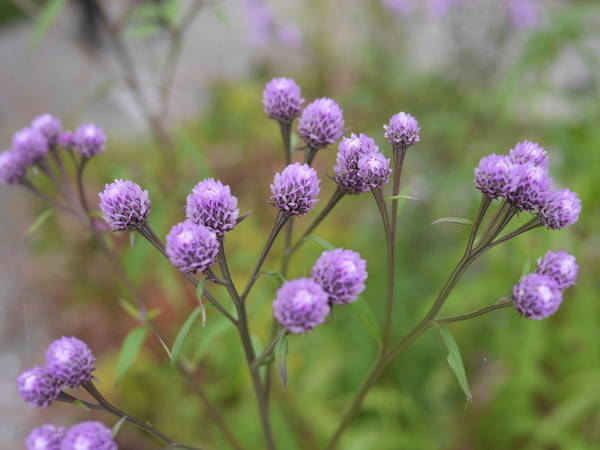
Saussurea pulchella ("Himehigotai")
Japanese name: ヒメヒゴタイ
Scientific name: Saussurea pulchella
[Overview]
A biennial 30–150 cm tall, growing in sunny grasslands.
It has a spindle-shaped root that extends vertically.
The stem is erect, often narrowly winged, and branches well in the upper part.
There are basal leaves and stem leaves; the basal leaves and the leaves on the lower part of the stem have withered by the flowering season.
The stem leaves are alternate; those in the middle of the stem are elliptic, 12–18 cm long, and herbaceous, either pinnately cut into 6–10 pairs of lobes or undivided with serrate margins.
Both surfaces of the leaves have glandular dots and short hairs.
The leaves have petioles.
The flower heads are red-purple, 1.2–1.6 cm across, and borne densely in large numbers in corymbs to panicles.
The involucre is bell-shaped to cylindrical, 1 cm across, covered with cobwebby hairs, and has one row of involucre at the base.
The involucral bracts are in 8–9 rows, and at the tip each has a pale red-purple, dry, membranous appendage that spreads outward.
The fruit is an achene with a pappus.
Details
Translated from our Japanese encyclopedia. If anything differs, the Japanese page is correct.