
Plant Encyclopedia

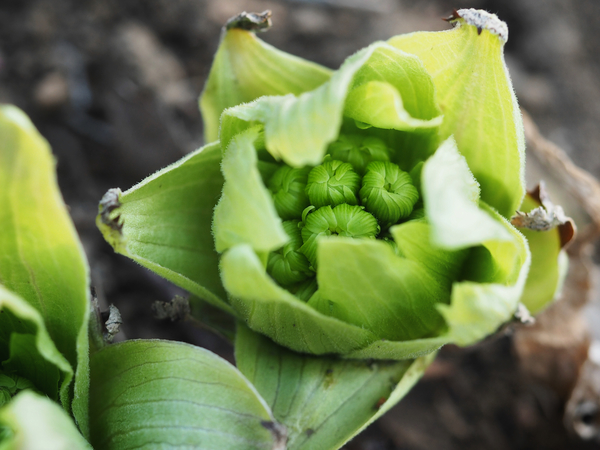
Petasites japonicus subsp. japonicus ("Fuki")
Japanese name: フキ (蕗)
Scientific name: Petasites japonicus subsp. japonicus
[Overview]
A perennial growing about 70 cm tall.
It is found along roadsides, on embankments and in vacant lots in mountains and hills.
It extends long underground stems and forms new plantlets at their tips.
The leaves arise from the tips of the underground stems after flowering; they are reniform-orbicular, about 15–30 cm wide, with a deeply cordate base.
The leaf margins have minutely protruding teeth.
Young leaves have short curled hairs on the upper surface and cobwebby hairs on the underside, but later become hairless.
The petiole is about 60 cm long and 1 cm in diameter.
It is dioecious.
In the summer of the previous year, flower buds form at the tips of the underground stems and overwinter wrapped in the bases of the petioles and in scale-like bracts.
In early spring of the following year, before the leaves emerge, the flower buds wrapped in bracts appear as ovoid flower shoots (to).
These are the fukinoto.
The flower stalk is 4–26 cm tall in male plants and 70 cm tall in female plants, and bears many white flower heads in a panicle.
The flower heads of male plants are 7–10 mm across and consist entirely of tubular bisexual flowers; they do not set fruit.
The flower heads of female plants are 7–10 mm across, with many female flowers at the margin and bisexual flowers in the center, and set fruit.
The corolla of the female flowers is thread-like.
The fruit is a cylindrical achene with a white pappus.
[Uses]
The fukinoto, petioles and leaves are eaten.
It is also used medicinally.
[Cultivation]
Propagate by underground stems.
It dislikes strong summer sun and is weak against heat and dryness, so it is best planted in partial shade such as under trees.
Details
Translated from our Japanese encyclopedia. If anything differs, the Japanese page is correct.