
Plant Encyclopedia

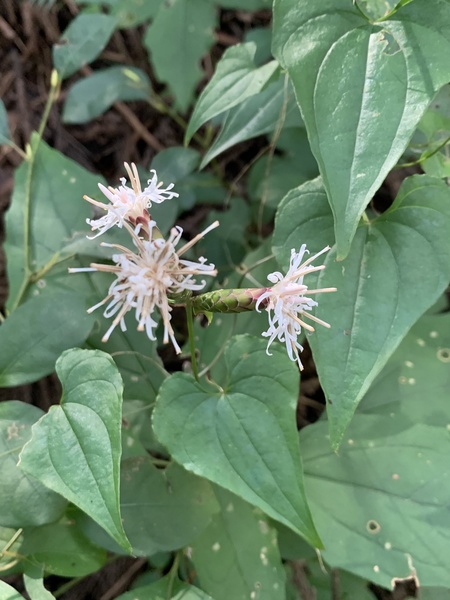
Pertya robusta var. robusta ("Kashiwabahaguma")
Japanese name: カシワバハグマ (柏葉白熊)
Scientific name: Pertya robusta var. robusta
[Overview]
A perennial 30–90 cm tall, found in slightly dry places in forests from hills to mountains.
It has a long, jointed rhizome.
The stem is erect and unbranched.
The leaves are simple and alternate, gathered somewhat in whorls around the middle of the stem; they are ovate-orbicular to ovate-elliptic, 10–20 cm long and 6–14 cm wide, with pointed tips and coarse teeth and short hairs along the margins.
They have long petioles.
A spike-like or raceme-like inflorescence at the stem tip bears several flower heads sparsely.
The flower heads consist of 9–14 white tubular florets.
The petals of the tubular florets are deeply 5-lobed, with the tips curled back.
The receptacle is densely covered with stiff bristles.
The fruit is an achene with a white to pale brown pappus.
[Cultivation]
Propagate from seed.
It prefers fertile, well-drained places that are sunny in spring and partly shaded in summer.
When planting in the ground, it is best to plant it under deciduous trees.
For potted plants, take care not to let them dry out, and water thoroughly when the soil surface dries; for plants in the ground, rainfall is sufficient unless sunny weather continues and the soil becomes dry.
In spring, apply slow-release fertilizer placed on the soil.
There are no particular pests or diseases.
[Notes]
The Japanese name likens the shape of the leaves to that of Kashiwa.
Details
Translated from our Japanese encyclopedia. If anything differs, the Japanese page is correct.