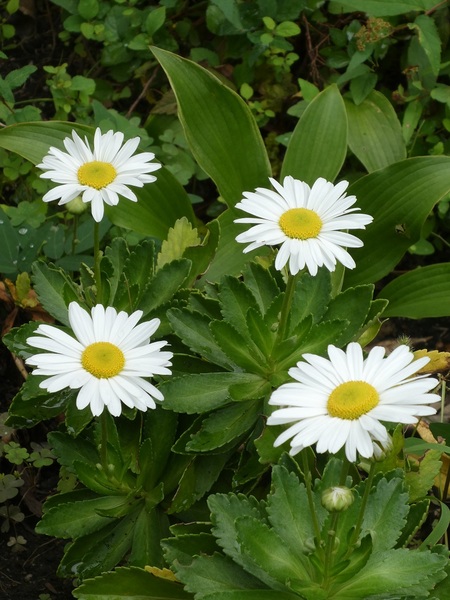
Japanese name: ハマギク(浜菊) Scientific name:Nipponanthemum nipponicum
[Overview]
A subshrub 0.5–1 m tall, found on coastal cliffs and sand dunes.
The stem becomes woody and branches.
The leaves are simple and alternate, spatulate, 5–9 cm long, thick and glossy.
The leaf margins are serrated.
There is no leaf stalk.
A flower head 6 cm across is borne at the tip of a long flower stalk; the ray florets are white and the tubular florets are yellow.
The involucre is hemispherical, and the involucral bracts are arranged in 4 rows.
The fruit is an achene.
[History]
It has been cultivated as an ornamental since the early Edo period.
[Cultivation]
Propagate from seed, by division, or by stem cuttings.
It prefers a sunny, well-drained, well-ventilated site.
For potted plants, water thoroughly when the soil surface dries from spring to autumn and keep it on the dry side in winter; for plants in the ground, rainfall is sufficient.
If basal fertilizer is applied, no further fertilizing is particularly necessary.
After flowering, it is good to cut it back to half its height to tidy its shape.
There are no particular pests or diseases.