
Plant Encyclopedia

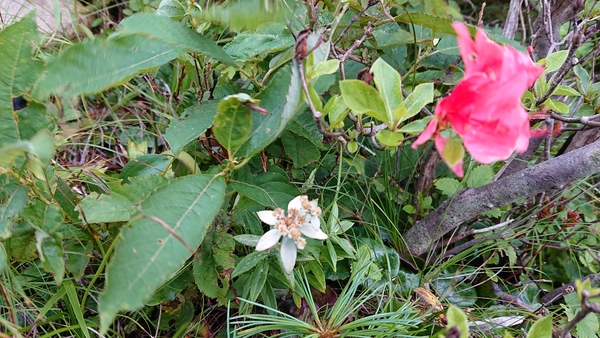
Leontopodium japonicum var. japonicum ("Usuyukiso")
Japanese name: ウスユキソウ (薄雪草)
Scientific name: Leontopodium japonicum var. japonicum
[Overview]
A perennial 25–50 cm tall, found in sunny grasslands, landslide areas and rocky places from the mountains to the subalpine zone.
It is densely covered with white cottony hairs and looks whitish overall.
The stems consist only of flowering stems, which grow in clumps and stand erect.
There are basal leaves and leaves arranged alternately on the stem; the basal leaves have withered by flowering time.
The stem leaves are lanceolate, 4–6 cm long, with entire margins and no leaf stalks, and the leaf bases do not clasp the stem.
The upper surface of the leaves has some white cottony hairs and is slightly glossy, while the underside is densely covered with white cottony hairs.
Several flower heads form densely at the tips of the stems and branches, surrounded by leaf-like bracts covered with white cottony hairs that spread in a star shape.
The fruit is an achene with a white pappus.
[Cultivation]
Propagate from seed or by division.
It prefers well-drained soil.
It is best planted in a deep pot, using potting soil for mountain wildflowers, a mixture of pumice and Kanuma soil, or mountain sand mixed with a little sphagnum moss.
It prefers an airy place; keep it in a sunny place from autumn to spring and in partial shade in summer, and avoid the western sun and dry cold winter winds.
Water so that the soil does not become too wet, but take care that it does not dry out too much, since the plant dislikes dryness; water in the morning from autumn to spring, and in summer after the temperature drops in the evening.
If the roots dry out, the plant often dies.
Fertilize sparingly; in addition to a base fertilizer, give liquid fertilizer once every 2 weeks to 1 month in spring or autumn as needed, and make sure no fertilizer remains in midsummer.
Aphids can occur.
[Notes]
The Japanese name comes from the plant's appearance, which looks as if covered with a thin layer of snow.
Details
Translated from our Japanese encyclopedia. If anything differs, the Japanese page is correct.