
Plant Encyclopedia

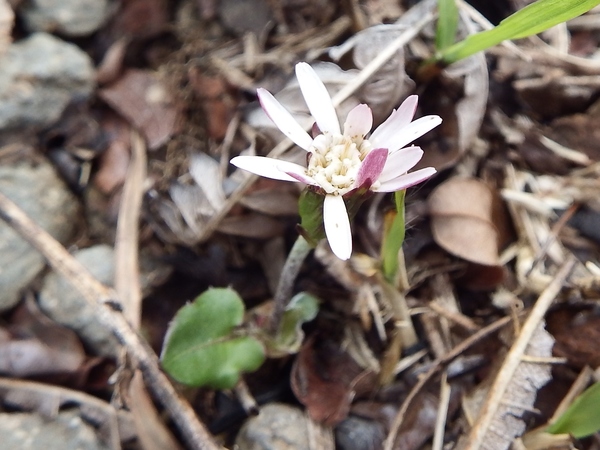
Leibnitzia anandria ("Senbon'yari")
Japanese name: センボンヤリ (千本槍)
Scientific name: Leibnitzia anandria
[Overview]
A perennial found in grassland and at woodland edges.
It has a short rhizome, and many leaves arise from the root in a rosette.
Its appearance differs between spring and autumn.
In spring it is 5–12 cm tall; the leaves are 2–6 cm long and 1–3 cm wide, densely covered with cobwebby hairs on the underside so that they appear white, and have short leaf stalks.
In spring, 1 to several flower stalks emerge, densely covered with cobwebby hairs, each bearing a flower head 1.5 cm across at the tip.
The flower head consists of ray florets and tubular florets and is white, with the underside of the ray florets purple.
In autumn it is 15–60 cm tall; the leaves are 6–15 cm long and 3–6 cm wide, pinnately lobed, and have long leaf stalks.
In autumn, several flower stalks emerge, sparsely covered with cobwebby hairs, each bearing a flower head at the tip.
The flower head consists of tubular florets and is a nearly conical cleistogamous (closed) flower.
The fruit is an achene with a brown pappus.
[Uses]
The whole plant is used medicinally.
[Cultivation]
Propagate by division or from seed.
It prefers a sunny, well-drained site.
Take care not to overwater; from spring to autumn, water thoroughly when the soil surface dries, and during winter dormancy water only enough to keep the soil from drying out completely.
Fertilizer is not particularly necessary, but if given, apply a small amount of organic fertilizer in spring.
There are no particular pests or diseases.
[Notes]
The name comes from the appearance of the autumn flowers.
The alternative name Murasaki-tanpopo comes from the spring flowers.
Details
Translated from our Japanese encyclopedia. If anything differs, the Japanese page is correct.