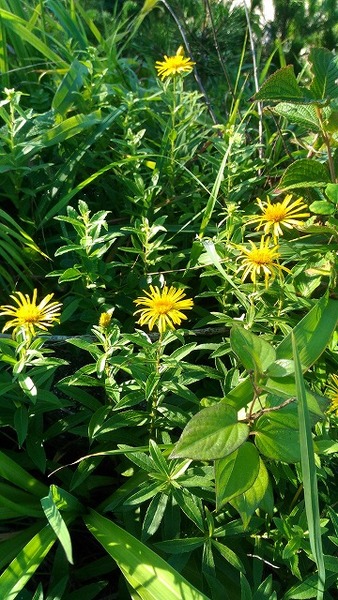
Japanese name: カセンソウ(歌仙草) Scientific name:Inula salicina var. asiatica
[Overview]
A perennial 40–80 cm tall, found in sunny grasslands.
It has slender creeping rhizomes.
The stem is erect, often branches in the upper part, and is hairy.
The leaves are of two kinds, basal leaves and stem leaves, and the basal leaves have withered by flowering.
The stem leaves are simple and alternate, oblong to lanceolate, 4–8 cm long, and the base clasps the stem.
The upper surface of the leaves is slightly glossy, and the veins stand out on the underside.
The leaf margins have small teeth.
Yellow flower heads 3.5–4 cm across are borne in corymbs, and the base of each flower head has a leaf-like bract.
The fruit is an achene.
[Cultivation]
Propagate by division or from seed.
It prefers sunny, well-drained soil.
For potted plants, water thoroughly when the soil surface dries; for plants in the ground, rainfall is sufficient.
Fertilizer is not particularly necessary.
There are no particular pests or diseases.