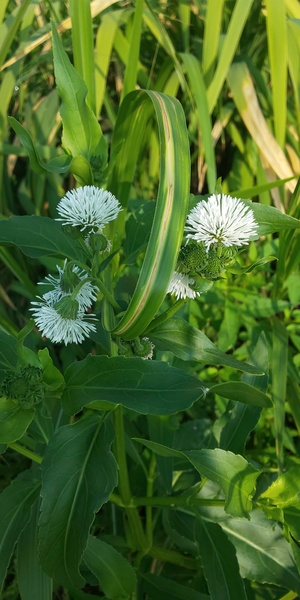
Japanese name: ミズヒマワリ(水向日葵) Scientific name:Gymnocoronis spilanthoides
[Overview]
A perennial 0.5–2 m tall, growing at the water's edge or in the water of rivers and similar places.
The stem is ridged.
Leaves are simple and opposite, ovate-lanceolate and up to 20 cm long, with a sharply pointed tip and low serrations on the margin; both surfaces are hairless.
The petiole is 1.5–3.5 cm long.
Flower heads are borne in panicles at the stem tips.
The flower heads are white and spherical, about 1 cm across.
The flower stalks and the stalks of the inflorescence are densely hairy.
The fruit is an achene with ridges.
Vegetative reproduction is extremely vigorous; even broken-off stems produce young plants, and large colonies form in a short time.
[History]
Plants introduced for aquariums escaped, and in 1995 they were confirmed to have become wild in a river in Aichi.
[Notes]
It is designated a "Specified Invasive Alien Species" under the Invasive Alien Species Act.
The Japanese name refers to its growing at the waterside and to its leaves, which are likened to those of the sunflower.