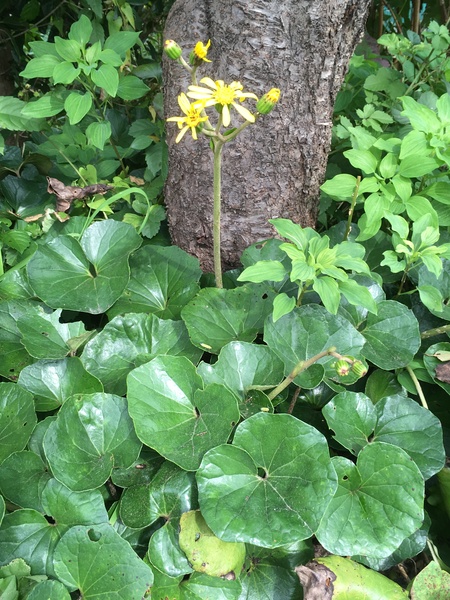
Farfugium japonicum var. japonicum(leopard plant, "Tsuwabuki")
Japanese name: ツワブキ(橐吾、橐) Scientific name:Farfugium japonicum var. japonicum
[Overview]
An evergreen perennial growing 30–75 cm tall, found on coastal rocks and cliffs, and on forest floors and at forest edges.
It has a thick rhizome and bears tufts of long-stalked basal leaves.
The leaves are reniform-orbicular, 4–15 cm long and 6.5–30 cm wide, entire or sometimes with irregular minute teeth, thick, and glossy on the upper surface.
The leaf stalks are about 10–40 cm long.
Young leaves are densely covered with grayish brown hairs.
Corymbs are borne at the tips of long flower stalks.
The flowers are yellow, 4–6 cm across, and fragrant.
[Uses]
The leaves are used as a folk remedy, for example by being roasted and applied to wounds. The young leaf stalks are eaten.
It has been planted in tea-room gardens since the early Edo period, and there are several cultivars.
[Cultivation]
Propagate from seed or by division.
It prefers partial shade and a well-drained site.
Cultivation is easy.
[Notes]
The Japanese name is a shortened form of "tsuya-buki" (glossy butterbur), so called because it is glossy and resembles the butterbur (fuki).