
Plant Encyclopedia

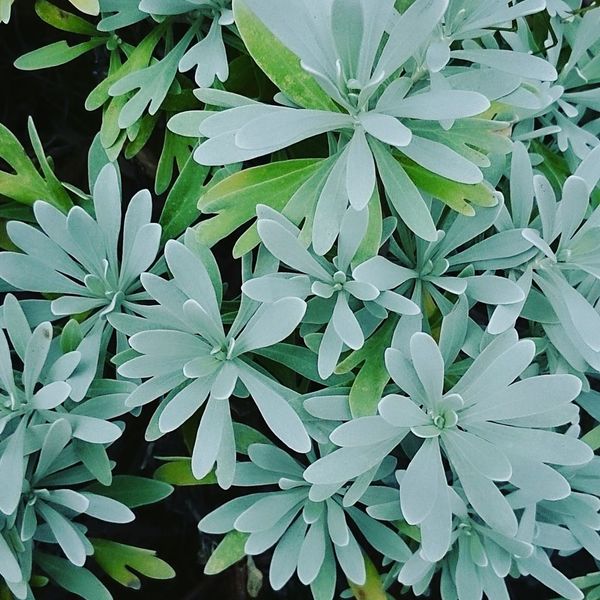
Crossostephium chinense ("Mokubyakko")
Japanese name: モクビャッコウ (木百香)
Scientific name: Crossostephium chinense
[Overview]
An evergreen shrub 30–50 cm tall, growing in places splashed by waves, such as coastal limestone and uplifted coral reefs.
The whole plant is densely covered with short grayish-white hairs and looks gray.
It also has a distinctive smell.
It branches well, and the trunk and branches become hard and woody.
The leaves are simple and alternate, a few centimeters long.
The lower leaves and the leaves at the branch tips are oblong-obovate, or deeply 3–5-lobed or deeply pinnately divided.
The leaves on the inflorescence are narrowly oblanceolate and entire.
The leaves are thick and soft.
Racemose or paniculate inflorescences emerge from the leaf axils and bear many flower heads.
The flowers are yellow, about 5 mm across, and consist of tubular florets only.
The flower heads have distinct stalks.
The fruit is an achene.
[Cultivation]
Propagate by cuttings.
It prefers a sunny, well-drained, dry place.
In poor sunlight the leaf color becomes poor.
It is sensitive to cold, so protect it from frost and cold wind and, if possible, keep it at 5°C or higher.
For plants in the ground, rainfall is sufficient.
For potted plants, water thoroughly when the soil surface dries; take care, as excess moisture causes root rot.
Keep it on the dry side in winter.
In spring to summer, apply slow-release fertilizer once every 2–3 months.
If it grows large and loses its balanced form, cut it back to a height of 15–20 cm, leaving a few leaves.
There are no particular pests or diseases.
Details
Translated from our Japanese encyclopedia. If anything differs, the Japanese page is correct.