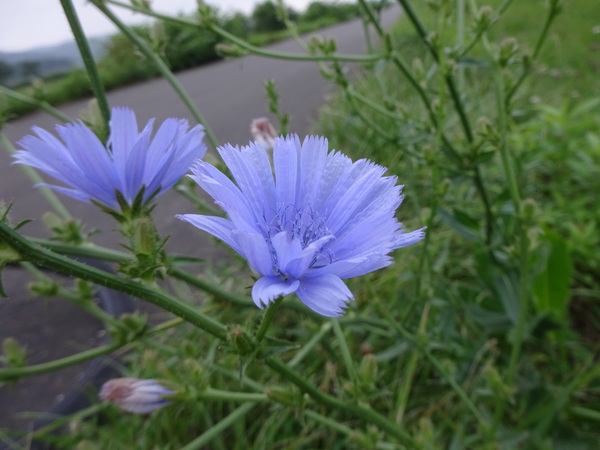
Japanese name: キクニガナ(菊苦菜) Scientific name:Cichorium intybus
[Overview]
A perennial 30–150 cm tall.
When the stems or leaves are damaged, they exude a white milky sap.
It has a taproot, and the roots grow deep.
The stems branch freely.
There are basal leaves and stem leaves, varying from broadly elliptic to pinnately cut.
The leaves on the stem are alternate and small.
The flowers are borne singly in the leaf axils or at the stem tips; each is a flower head 2–4 cm across consisting only of pale blue-violet ray florets.
Flower colors also include pale blue, white and pink.
The fruit is an achene.
[History]
It is said to have been cultivated since Greek and Roman times.
It came to Japan in the first years of the Meiji era.
[Uses]
It has a distinctive bitterness, and the blanched leaves are used in salads and similar dishes.
The roots and rhizomes are used medicinally and also as a substitute for coffee.
[Cultivation]
Propagate from seed.
It prefers sunny, well-drained, fertile, alkaline soil.
It dislikes heat and humidity, so a cool, airy place is best in summer.
Because it has a taproot and the roots grow deep, cultivate the soil deeply.
Rainfall is sufficient for watering.
In addition to base fertilizer, apply slow-release fertilizer about once a month from spring to autumn.
Pests and diseases include aphids.