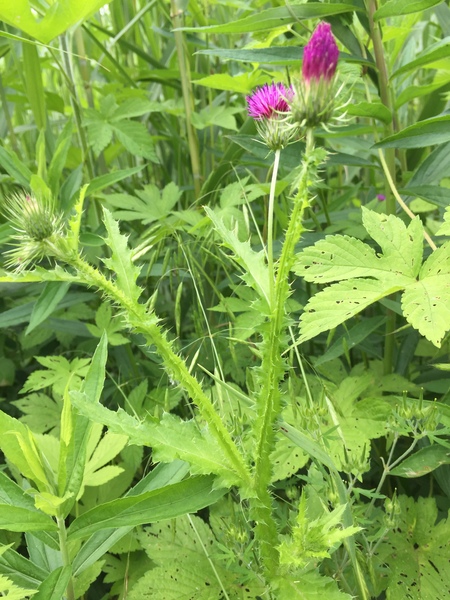
Japanese name: ヒレアザミ(鰭薊) Scientific name:Carduus crispus
[Overview]
A biennial or perennial 0.6–1.2 m tall, growing on riverbank embankments and in vacant lots.
The stem has two spiny, fin-like wings, is erect, and branches in the upper part, with the branches extending at wide angles.
There are basal leaves and stem leaves; the basal leaves have withered by the flowering season.
The stem leaves are alternate and elliptic, 5–30 cm long, either pinnately divided into 5–8 pairs of lobes or undivided with toothed margins, and there are spines on the lobes, teeth and leaf tip.
Flower heads are borne at the stem tips; they are pale pinkish purple and consist only of tubular florets.
The involucre is bell-shaped to ovoid-globose, about 1.5–3 cm wide, and the involucral bracts are in 7–8 rows, ascending, with tips forming sharp spines.
The fruit is an achene with a pappus.
[History]
It is considered a prehistoric naturalized plant that came from the Asian continent along with agriculture.