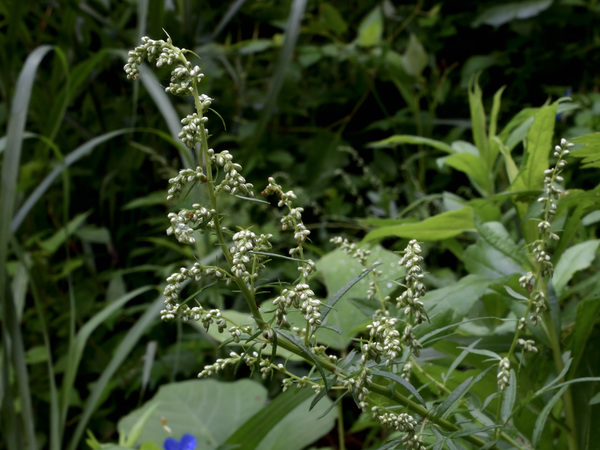
Artemisia indica var. maximowiczii(Korean wormwood, "Yomogi")
Japanese name: ヨモギ(艾、蓬) Scientific name:Artemisia indica var. maximowiczii
[Overview]
A perennial commonly seen in hills and fields.
The stem becomes somewhat woody, grows 50–100 cm tall, and branches freely.
The leaves are simple and alternate; those in the middle of the stem are elliptic, 6–12 cm long and 4–8 cm wide, deeply pinnately cut with 2–4 pairs of segments, and have teeth along the margin.
The undersides of the leaves are densely covered with cottony hairs and appear grayish white.
A large panicle at the stem tip bears many flower heads.
The flower heads are narrowly bell-shaped, 2.5–3.5 mm long and 1.5 mm wide, with no ray florets.
It is wind-pollinated.
The fruit is an achene 1.5 mm long.
[Uses]
The leaves have a distinctive fragrance, and the new shoots in spring are used in kusamochi (yomogi rice cakes), tempura, ohitashi and other dishes.
The cottony hairs on the leaves become moxa (mogusa) and are used for moxibustion.
The leaves are called gaiyo and are used medicinally.