
Plant Encyclopedia

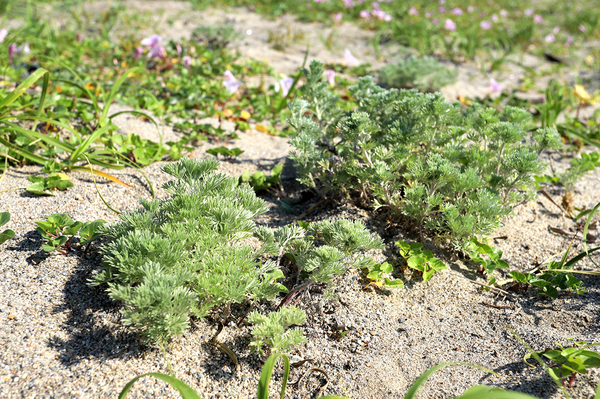
Artemisia capillaris (capillary wormwood, "Kawarayomogi")
Japanese name: カワラヨモギ (河原蓬)
Scientific name: Artemisia capillaris
[Overview]
A perennial 30–100 cm tall, found on sandy ground along seashores and riverbanks.
The base of the stem becomes woody, forming a subshrub.
Non-flowering stems are short and bear leaves in a rosette.
The rosette leaves are 1.5–3.8 cm wide and bipinnately divided to the base, with thread-like segments; both surfaces are usually densely covered with silky hairs and appear grayish white.
The rosette leaves have petioles 2–3 cm long.
The flower stalk branches freely, and the leaves on it are alternate, 1.5–9 cm long and 1–7 cm wide, once- or twice-pinnately divided to the base, with thread-like segments; both surfaces are either silky-haired or hairless.
The bases of the leaves on the flower stalk clasp the stem.
A large panicle at the stem tip bears many flower heads.
The flower heads are spherical to ovoid, 1.5–2 mm in both length and width, with no ray florets.
It is wind-pollinated.
The fruit is an achene 0.8 mm long.
[Uses]
The flower heads are called inchinko and the young stems and leaves are called men-inchin; both are used medicinally.
Details
Japanese: カワラヨモギ(河原蓬)、ハマヨモギ(浜蓬)、ネズミヨモギ(鼠蓬)、イヌヨモギ(犬蓬)
Translated from our Japanese encyclopedia. If anything differs, the Japanese page is correct.