EVERGREEN

Plant Encyclopedia

Arctium lappa

Arctium lappa (greater burdock, "Gobo")

Japanese name: ゴボウ (牛蒡)
Scientific name: Arctium lappa

Arctium lappa

[Overview]
A biennial up to 3 m tall.
A sturdy taproot extends deep underground.
The stem branches freely.
The leaves are simple and alternate, ovate to heart-shaped, up to 30 cm long, with soft hairs on the underside.
They have petioles.
Flower heads about 4.5 cm across are borne in corymb-like clusters.
The flower heads consist entirely of reddish-purple tubular florets.
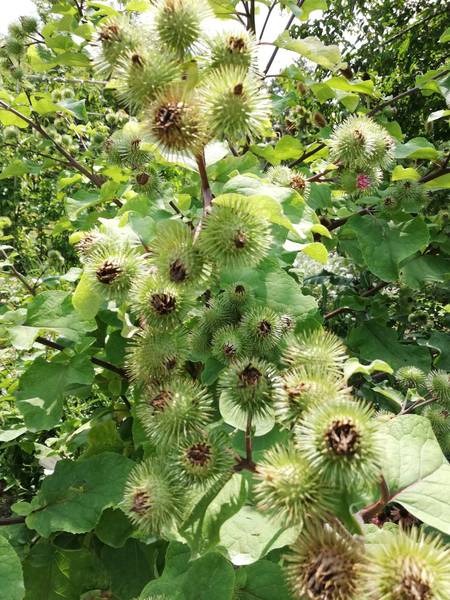
The involucre is spherical and bears many involucral bracts whose tips form hooked spines.
The fruit is an achene with a pappus.

[Uses]
The root is eaten, and the fruit is used medicinally.

[Cultivation]
Propagate from seed.
Because the roots grow deep, a site with deep cultivated soil is suitable.
It dislikes acidic soil.
It prefers a sunny, well-drained site.
Pests and diseases include powdery mildew, root-knot nematodes and root-lesion nematodes.

Details

Names
English: greater burdock, edible burdock
Japanese: ゴボウ(牛蒡)
Life form
Biennial
Habit
Terrestrial
Planting (or sowing) season
March, April, May, September, October
Flowering season
May, June, July, August, September
Distribution or origin
Europe to northeastern China
Height
3000 mm
Leaf shape
Simple leaf (unlobed)
Leaf arrangement
Alternate
Inflorescence
Head
Flower color
Purple
Leaf color
Green
Availability of seeds and plants
Low
Form sold
Seeds
Propagation
Seed
Sun exposure
Full sun
Water needs
Moderate
Soil needs
Required
Soil acidity
Alkaline, Neutral
Tolerance
Cold tolerance
Suitable uses
Parks and gardens
Diseases
Powdery mildew
Pests
Root-knot nematodes, Root-lesion nematodes
Edible parts
Roots
Uses
Edible, Medicinal

Translated from our Japanese encyclopedia. If anything differs, the Japanese page is correct.

Sponsored