
Plant Encyclopedia

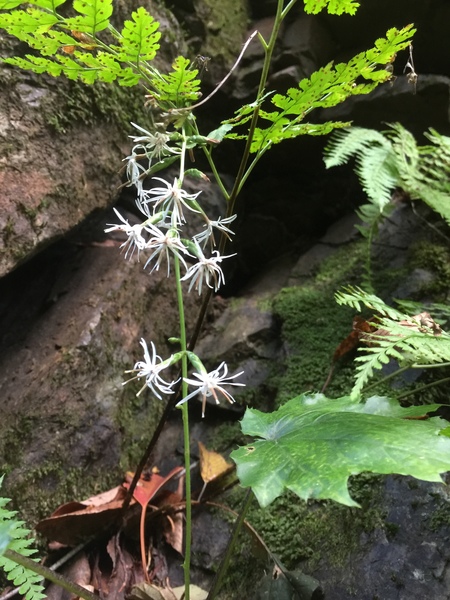
Ainsliaea acerifolia var. subapoda ("Okumomijihaguma")
Japanese name: オクモミジハグマ (奥紅葉白熊)
Scientific name: Ainsliaea acerifolia var. subapoda
[Overview]
A perennial about 40–80 cm tall, found in the shade of trees in mountain forests.
It prefers soil rich in humus and often grows in colonies.
The underground stems creep horizontally.
Four to seven leaves are borne alternately but appear whorled at the middle of the stem; they are kidney-shaped to round, about 6–12 cm long and 6–18 cm wide, shallowly palmately 7-lobed, with a heart-shaped base.
Both surfaces of the leaves are sparsely covered with soft hairs, and the margins are toothed.
The petioles are long.
A spike-like inflorescence at the stem tip bears many flower heads that bloom facing sideways.
Each flower head has 3 florets; the florets are white, and the petals are twisted like a pinwheel.
The fruit is a hairless achene with a feathery pappus.
[Cultivation]
Propagate from seed or by division.
It prefers soil that is both well drained and moisture-retentive; use soil for mountain wildflowers, or akadama soil mixed with pumice.
Keep it in a place that is sunny in early spring and in partial shade in summer so that it stays cool.
For plants in the ground, it is good to plant them under deciduous trees.
For potted plants, take care that the soil does not dry out, and water thoroughly when the soil surface dries; in summer, water during the cooler hours of the day.
In spring and autumn, apply slow-release fertilizer placed on the soil.
There are no particular pests or diseases.
Details
Translated from our Japanese encyclopedia. If anything differs, the Japanese page is correct.