
Plant Encyclopedia

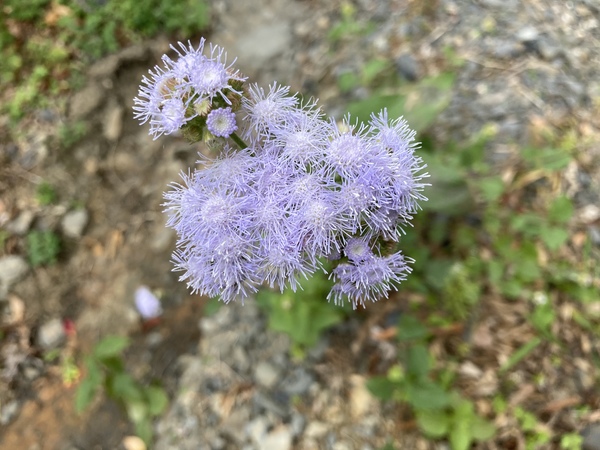
Ageratum houstonianum (flossflower, "Murasakikakkoazami")
Japanese name: ムラサキカッコウアザミ (紫霍香薊)
Scientific name: Ageratum houstonianum
[Overview]
In its native range it is an evergreen perennial or subshrub, but it is sensitive to cold and so is an annual in Japan.
It grows 0.3–1 m tall and is covered with long white soft hairs.
The stem branches in the upper part.
Leaves are simple and opposite, though they are sometimes alternate in the upper part of the stem.
The leaves are ovate to triangular-ovate, 2–7 cm long, with a blunt tip, a shallowly heart-shaped base, and toothed margins.
Leaves become smaller and petioles shorter toward the top of the stem.
Flower heads about 0.7 cm across are borne at the stem tips in corymbs to panicles.
The flower heads consist only of tubular flowers and are bluish purple, pink, white, and so on.
The style is 2-lobed, protrudes far out, and is the same color as the flower.
The involucre is hemispherical, and the involucral bracts are hairy.
The fruit is a black achene with a very short pappus.
[History]
Plants introduced for horticulture have escaped from cultivation in warm regions.
[Cultivation]
Propagate from seed or by stem cuttings.
The seed needs light to germinate, so sow it in seed-sowing soil without covering it with soil, and water from the bottom so the soil does not dry out.
The optimum temperature for germination is 15–25 °C.
It prefers sunny, well-drained soil.
Take care not to overwater; for potted plants, water thoroughly when the soil surface dries, and for plants in the ground, rainfall is sufficient.
For plants in the ground, a small amount of base fertilizer is enough and nothing more is needed; even for potted plants, it is better to fertilize sparingly.
If too much fertilizer is given (especially one high in nitrogen), the plant produces only leaves and is slow to flower.
When plants become crowded they get stuffy and prone to disease, so remove crowded branches.
Pests and diseases include gray mold, aphids and spider mites.
Details
Japanese: ムラサキカッコウアザミ(紫霍香薊)、オオカッコウアザミ(大霍香薊)、アゲラタム、アゲラツム
Translated from our Japanese encyclopedia. If anything differs, the Japanese page is correct.