
Plant Encyclopedia

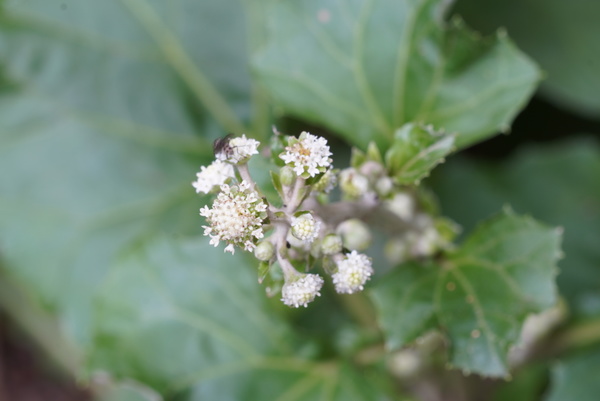
Adenocaulon himalaicum ("Nobuki")
Japanese name: ノブキ (野蕗)
Scientific name: Adenocaulon himalaicum
[Overview]
A perennial found in the shade of trees in the mountains, growing 30–100 cm tall.
It has creeping horizontal rhizomes.
The stem branches in the upper part and bears stalked glands.
The leaves are simple and alternate, clustered at the base of the plant, triangular-cordate, 5–13 cm long and 9–22 cm wide, with a somewhat pointed tip and dense white woolly hairs on the underside.
They have long petioles with narrow wings.
Small white flower heads are borne at the branch tips, forming a conical spike.
The flower heads consist only of tubular florets; the 7–11 florets on the outer part are female with a 4–5-lobed corolla, and the 7–18 florets on the inner part are functionally male bisexual flowers with a 5-lobed corolla.
The involucre is hemispherical, with 5–7 involucral bracts.
Only the female flowers set fruit; the central bisexual flowers do not set fruit and fall off, so the fruits (achenes) are arranged radially.
The achenes are club-shaped, without a pappus, and ripen black.
The upper part of the achene has stalked glands that are sticky, and the fruits are dispersed by clinging to animals and clothing, so the plant is often seen along mountain paths.
[Uses]
The young shoots are eaten as a wild vegetable, and the stems and leaves are used medicinally.
[Cultivation]
Propagate from seed.
A location in partial shade that is well drained and moderately moist is suitable.
Details
Translated from our Japanese encyclopedia. If anything differs, the Japanese page is correct.