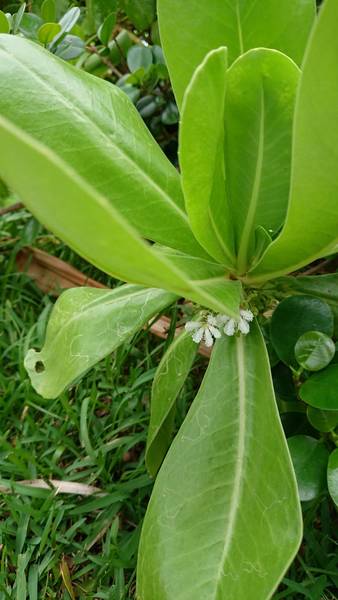
Japanese name: クサトベラ Scientific name:Scaevola taccada
[Overview]
An evergreen shrub 1–2 m tall, growing on coastal sands and among rocks.
It branches sparsely, and the twigs are brittle and break easily.
The leaves are simple and alternate, clustered at the branch tips, obovate-spatulate, 10–15 cm long and 4–6 cm wide, soft in texture, with the base gradually narrowing into the petiole.
Cymes 3–6 cm long emerge from the leaf axils and bear 5–10 flowers.
The flowers are white; the corolla is deeply 5-lobed, and because the upper part of the corolla tube is split down to the base, the lobes spread out like a fan.
The inside of the flower has slightly curled silky hairs.
There are 5 stamens.
The fruit is a drupe 0.8–1 cm long that ripens white and is dispersed by floating on seawater.
[Uses]
The leaves, wood and roots are used medicinally.