
Plant Encyclopedia

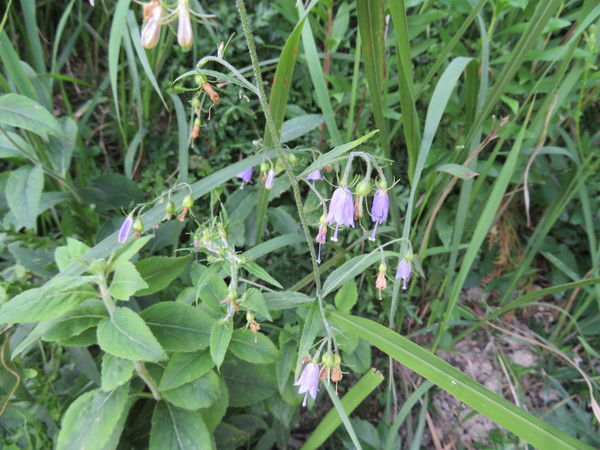
Adenophora triphylla var. japonica ("Tsuriganeninjin")
Japanese name: ツリガネニンジン (釣鐘人参)
Scientific name: Adenophora triphylla var. japonica
[Overview]
A perennial 20–100 cm tall, commonly seen in hills and fields.
It has a thick rhizome.
Milky sap comes out when the stem is cut.
There are basal leaves and stem leaves; the basal leaves are round-heart-shaped with long petioles.
The leaves on the stem are usually simple and borne in whorls of 3–4, sometimes opposite or alternate.
The leaves are 2–15 cm long, vary in shape from linear to elliptic, have pointed tips and serrated margins, and have very short petioles.
On branches that are alternate or whorled at the stem tip, 1 to several flowers are borne facing downward, and the whole forms a panicle-like inflorescence.
The flowers are bell-shaped, 0.8–2 cm long, 5-lobed, and pale purple or white.
The style protrudes slightly from the flower or is the same length as the corolla.
The fruit is a capsule.
[Uses]
The root is used medicinally.
The young shoots can be eaten as wild vegetables.
[Cultivation]
Propagate from seed, by division, or by shoot cuttings.
It prefers sunny, well-drained soil.
For potted plants, water thoroughly when the soil surface dries; for plants in the ground, watering is not particularly necessary unless sunny weather continues and the soil dries out.
Apply oil cake in spring.
There are no particular pests or diseases.
Details
Translated from our Japanese encyclopedia. If anything differs, the Japanese page is correct.