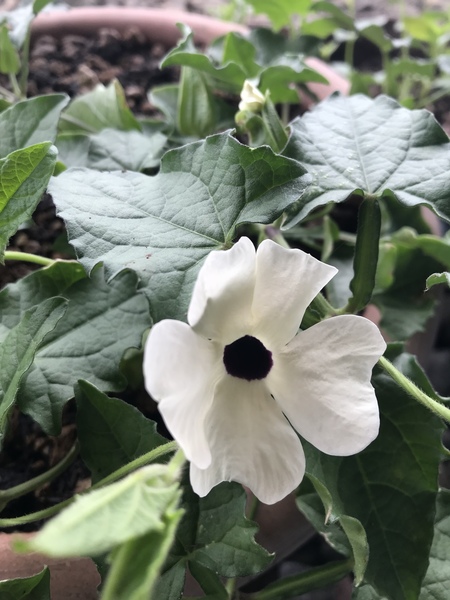
Thunbergia alata(black-eyed Susan vine, "Yahazukazura")
Japanese name: ヤハズカズラ(矢筈葛) Scientific name:Thunbergia alata
[Overview]
A climbing perennial 1–2.5 m tall, but because it has weak cold tolerance, in Japan it is mainly treated as a climbing annual.
The stem is 4-ridged and hairy.
Leaves are simple and opposite, triangular-ovate, 4–7 cm long, with a heart-shaped to arrowhead-shaped base.
The leaf margin has wavy teeth or is entire.
The petiole is as long as the leaf and has wings.
From the leaf axils at the stem tips it produces flower stalks longer than the petioles, each bearing a single flower 3.5–4.5 cm across.
The flowers are funnel-shaped with a 5-lobed tip and a narrow floral tube.
The flower color is yellow-orange, and the inside of the floral tube is blackish purple.
The bracts are ovate and bear coarse hairs.
The fruit is a capsule.
[Cultivation]
Propagate from seed or by cuttings.
It prefers sunny, well-drained soil.
Potted plants can overwinter if brought indoors to a sunny spot in winter.
For potted plants, from spring to autumn water thoroughly when the soil surface dries and keep on the dry side in winter; for plants in the ground, rainfall is sufficient.
In spring to autumn, apply slow-release fertilizer placed on the soil.
Spider mites can occur.