
Plant Encyclopedia

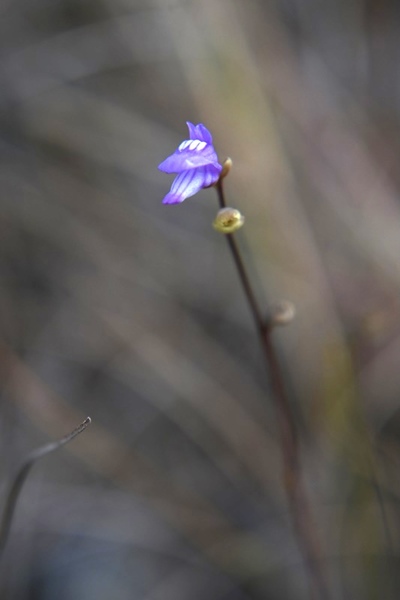
Utricularia caerulea (blue bladderwort, "Hozakinomimikakigusa")
Japanese name: ホザキノミミカキグサ (穂咲耳掻草)
Scientific name: Utricularia caerulea
[Overview]
A perennial found in sphagnum moss in wetlands and similar places.
A carnivorous plant.
White thread-like underground stems creep horizontally; in water or mud they bear linear aquatic leaves, and near the ground surface they bear aerial leaves.
The aerial leaves are spatulate, about 0.2–0.3 cm long, entire and hairless.
Bladders are borne on the underground stems and elsewhere.
The bladders are ovoid, about 0.2–1 mm in diameter, with a mouth at the tip; the mouth has a valve that opens inward, and when microorganisms approach, the valve opens and sucks them in.
A raceme on an erect flower stalk 5–40 cm tall bears 4–10 flowers.
Scale leaves are attached in a shield-like manner on the lower part of the flower stalk.
The flowers are purple and lipped, with the base of the lower lip swollen and purple streaks and yellow markings on the palate.
Behind the flower is a conical, downward-pointing spur that curves forward and projects beyond the lower lip.
The flower stalk is very short.
The fruit is a capsule enclosed by the calyx.
[Cultivation]
Propagate from seed or by division.
Sow seed as soon as it is collected.
Plant it in sphagnum moss or peat moss alone and keep it in a sunny place.
Stand the pot in a tray of water so that it always stays moist.
Fertilizer is not particularly necessary.
There are no particular pests or diseases.
Details
Japanese: ホザキノミミカキグサ(穂咲耳掻草)、ホザキミミカキグサ(穂咲耳掻草)
Translated from our Japanese encyclopedia. If anything differs, the Japanese page is correct.