
Plant Encyclopedia

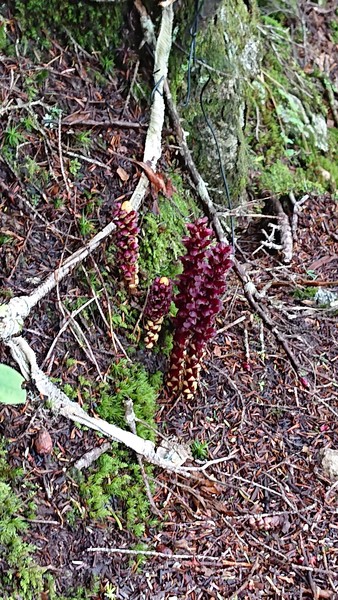
Boschniakia rossica (northern groundcone, "Oniku")
Japanese name: オニク (御肉)
Scientific name: Boschniakia rossica
[Overview]
An annual 15–30 cm tall that parasitizes the roots of plants of the genus Hannoki.
In Japan it is found in the subalpine zone, where it parasitizes Miyama-hannoki.
It has no chlorophyll.
It has a thick, lumpy rhizome covered with scale leaves, from which several stems stand upright.
The stems are cylindrical, thick, fleshy and dark purple, with scale leaves densely arranged alternately.
The scale leaves are yellow to yellowish brown, triangular and thick.
A spike-like inflorescence about half the length of the stem is produced, densely bearing many dark purple flowers.
There is a triangular bract at the base of each flower.
The flowers are two-lipped and swollen into a pot shape; the upper lip is shallowly 2-lobed and longer than the lower lip, and the lower lip is 3-lobed.
There are 4 stamens.
The style is shallowly 2-lobed.
The calyx is dark purple and cup-shaped, irregularly divided into 5 lobes.
The fruit is an ovoid capsule containing many seeds.
[Uses]
The whole plant is used medicinally.
[Notes]
Like Matatabi, it is liked by cats.
Details
Japanese: オニク(御肉)、キムラタケ(黄紫茸)
Translated from our Japanese encyclopedia. If anything differs, the Japanese page is correct.