
Plant Encyclopedia

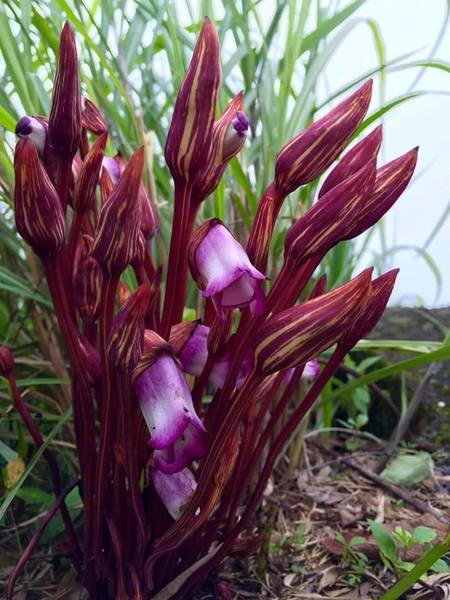
Aeginetia indica (Indian broomrape, "Nanbangiseru")
Japanese name: ナンバンギセル (南蛮煙管)
Scientific name: Aeginetia indica
[Overview]
An annual parasitic plant commonly seen in hills and fields.
It has no chlorophyll; it parasitizes the roots of monocots, mainly in the grass family, and grows on nutrients absorbed from the host's roots.
In Japan it usually parasitizes Susuki, but in the tropics it parasitizes sugarcane, Yucca, and members of the ginger family.
The whole plant is hairless, and the stem is very short and hardly emerges above ground.
The leaves are triangular, 5–10 mm long and 3–4 mm wide, yellowish brown and scale-like, and are borne sparsely on the stem.
Several flower stalks about 15–30 cm long emerge from the leaf axils, each bearing a single flower at its tip.
The flower stalk is reddish brown, or yellowish brown with reddish brown stripes.
The flowers open sideways; they are thick and tubular, 3–5 cm long, with the tip shallowly divided into 5 lobes, and pale reddish purple.
The margins of the corolla lobes are entire.
The calyx is 1–3.5 cm long, sheath-like, sharply pointed at the tip, and marked with reddish purple streaks.
The fruit is a globose capsule 1–1.5 cm long.
It contains many fine, powdery seeds.
[History]
It appears in the Man'yoshu under the name omoigusa (思草).
[Cultivation]
Propagate from seed.
The seeds germinate and send out roots when they attach to the roots of the host plant they parasitize, so expose the host's roots, sow the seeds in winter to spring, and then replace the soil.
Cultivation follows the growing conditions of the host.
There are no particular pests or diseases.
[Notes]
The Japanese name compares the shape of the flower to a pipe.
Details
Japanese: ナンバンギセル(南蛮煙管)、オモイグサ(思草)、ヒメナンバンギセル(姫南蛮煙管)、ムニンギセル(無人煙管)
Translated from our Japanese encyclopedia. If anything differs, the Japanese page is correct.