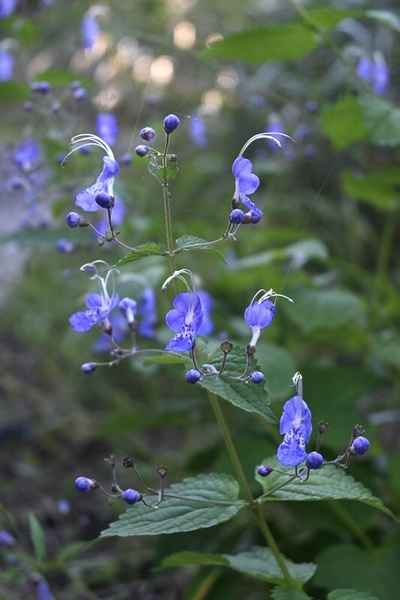
Japanese name: カリガネソウ(雁草、雁金草) Scientific name:Tripora divaricata
[Overview]
A perennial about 1 m tall, found at forest edges in low mountains.
The stem has 4 ridges, branches in the upper part, and becomes woody in the lower part.
Leaves are simple and opposite, broadly ovate, 5–13 cm long and 2.5–8 cm wide.
The leaf margins have teeth.
The leaf stalk is 0.5–4 cm long.
Cymes borne at the stem tips and in the leaf axils bear sparse flowers.
The flowers are bluish purple and two-lipped, and the central lobe of the 3-lobed lower lip is especially large.
The stamens and style stick out above the flower and curve.
The fruit is a schizocarp.
[Uses]
The leaves are used medicinally.
[Cultivation]
Propagate from seed, by division, or by bud cuttings.
It prefers well-drained soil in sun to partial shade.
Avoid places that get strong afternoon sun or that become dry.
If the conditions suit it, it grows well and multiplies.
There are no particular pests or diseases.
[Notes]
The Japanese name compares the shape of the flower to a flying wild goose.