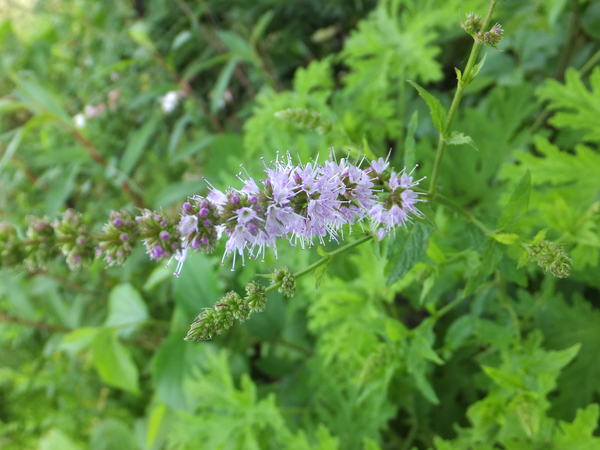
Japanese name: ナガバハッカ(長葉薄荷) Scientific name:Mentha longifolia
[Overview]
A perennial 40–120 cm tall.
The stems and leaves bear soft white hairs, and the whole plant is fragrant.
The stem is square in cross section.
Leaves are simple and opposite, oblong to lanceolate, 5–10 cm long and 1.5–3 cm wide.
The leaf margins are serrate.
Verticillasters are produced at the stem tips.
The flowers are two-lipped and 4-lobed, pale purple to white.
[Uses]
It is cultivated as a herb and used to flavor cooking and for medicinal purposes.
[Cultivation]
Propagate by division or stem cuttings.
It prefers slightly moist, well-drained soil in sun to bright shade.
It is hardy and spreads by underground stems, so when planting in a garden, it is better to make a barrier underground to keep it from spreading too much.
For potted plants, water when the soil surface dries.
Fertilizer is not particularly necessary, and too much weakens the fragrance.
It is strongly drought tolerant and also tolerates heat and humidity, but if the branches become crowded, they become stuffy and disease may occur.