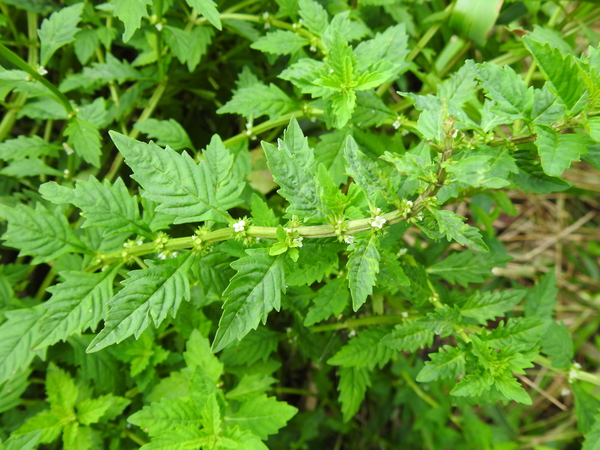
Japanese name: エゾシロネ(蝦夷白根) Scientific name:Lycopus uniflorus
[Overview]
A perennial 10–50 cm tall, found in wetlands and moist places in woods.
It has thread-like underground stems that form spindle-shaped tubers at their tips, and it overwinters by these tubers.
The stem stands erect from the tuber and is square in cross section; it is usually unbranched, purplish at the base, and covered with fine hairs.
Leaves are simple and opposite, rhombic-ovate to oblong, 2–7 cm long and 1–2.5 cm wide.
The leaves are not glossy, have very fine hairs, and have coarse teeth along the margin.
White lipped flowers about 2 mm long are borne in the leaf axils.
The calyx is 5-lobed, and the tips of the lobes are not very pointed.
The fruit is a 3-angled schizocarp, longer than the calyx, with 4 projections at the tip.