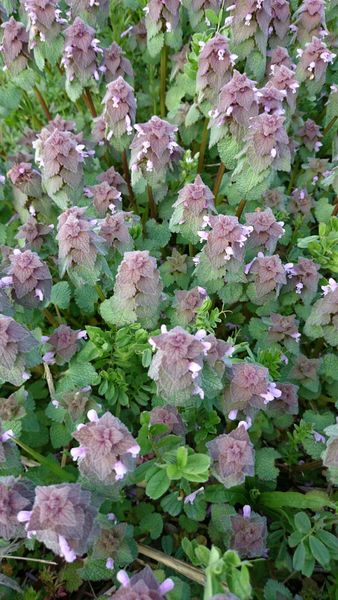
Japanese name: ヒメオドリコソウ Scientific name:Lamium purpureum
[Overview]
A biennial 10–25 cm tall, found along roadsides, in fields, and on embankments.
The stem is erect, branches at the base, and is square in cross section.
The stem has short white hairs.
The leaves are simple and opposite, round-cordate to ovate, 1.5–3 cm in both length and width, with rounded teeth.
The leaf surface is netted with depressions, so it looks crinkled, and both surfaces have fine hairs.
The leaves on the upper part of the stem are densely set, have short petioles, and are often tinged reddish purple at flowering time.
The leaves on the lower part of the stem have long petioles.
The reddish purple flowers are densely set in the axils of the upper leaves.
The corolla is a lipped flower 1 cm long, hairy on the outside.
The calyx is hairy.
The fruit is a schizocarp.
[History]
It has naturalized widely around the world, and in Japan it was first found in Tokyo in the mid-Meiji era (1893).