
Plant Encyclopedia

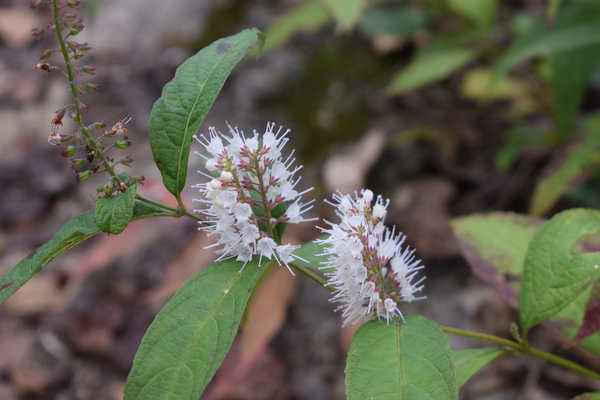
Keiskea japonica ("Shimobashira")
Japanese name: シモバシラ (霜柱)
Scientific name: Keiskea japonica
[Overview]
A perennial 40–70 cm tall, growing in mountain woods.
It often grows in colonies.
A woody underground stem creeps long through the soil.
The stem is square in cross-section.
Leaves are simple and opposite, oblong, 8–20 cm long and 3–5.5 cm wide, with pointed tips, toothed margins and short leaf stalks.
The upper surface of the leaf is rough, with fine hairs on the veins, and the underside has glandular dots.
An inflorescence 5–12 cm long stands upright from the leaf axils and stem tips, densely bearing many flowers on one side.
The flowers are white and lipped; the corolla is tubular-bell-shaped, about 0.7 cm long, with the upper lip 2-lobed and the lower lip 3-lobed.
There are 4 stamens, which project far out of the flower.
The fruit splits into mericarps, and only 1 of the 4 ripens.
[Cultivation]
Propagate from seed, by division, or by cuttings.
It prefers a well-drained, moisture-retentive, airy place in partial shade.
For potted plants, water thoroughly when the soil surface dries; for plants in the ground, rainfall is sufficient.
Apply slow-release fertilizer in spring and autumn.
If you wish to see frost columns, when the aboveground parts wither, prune the stems leaving them rather long.
There are no particular pests or diseases.
[Notes]
Even after the aboveground parts wither in winter, water rises by capillary action, and ice crystals like frost columns emerge from the base of the dead stems.
They can be seen especially in early winter, on very cold mornings up to about 2 weeks after the first frost.
The Japanese name derives from this phenomenon.
Details
Translated from our Japanese encyclopedia. If anything differs, the Japanese page is correct.