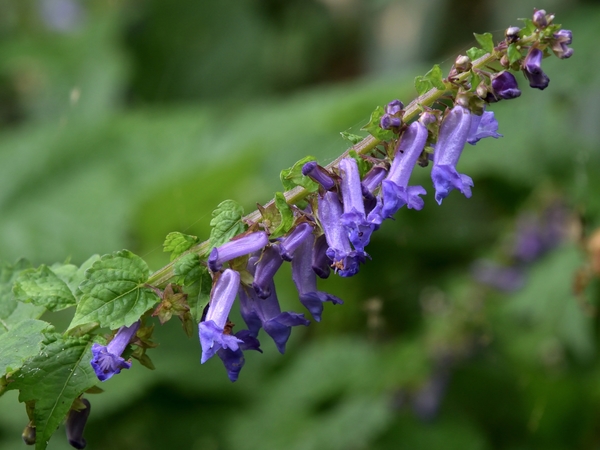
Isodon umbrosus var. leucanthus f. kameba("Kamebahikiokoshi")
Japanese name: カメバヒキオコシ(亀葉引起) Scientific name:Isodon umbrosus var. leucanthus f. kameba
[Overview]
A perennial 60–90 cm tall, found in woods and at woodland edges.
The stem has downward-pointing hairs and is square in cross-section.
Leaves are opposite and broadly ovate, 4–10 cm long, with the tip divided into 3 lobes and the central lobe extending into a tail.
The leaf margin has teeth apart from the central lobe.
Flowers are borne in inflorescences arising from the leaf axils and stem tips.
The flowers are blue-purple, two-lipped, and 0.8–1 cm long.
The fruit splits into 4 mericarps.
[Cultivation]
Propagate by division.
It prefers fertile, well-drained soil in sun to partial shade.
When planted in the ground, it is best planted under deciduous trees.
For potted plants, water thoroughly from spring to autumn when the soil surface dries; in winter, water so that the soil does not dry out completely, or leave the pot where it is exposed to rain.
For plants in the ground, rainfall is sufficient.
From spring to autumn, place slow-release fertilizer on the soil.
There are no particular pests or diseases.
[Notes]
The Japanese name compares the shape of the leaf to a turtle.