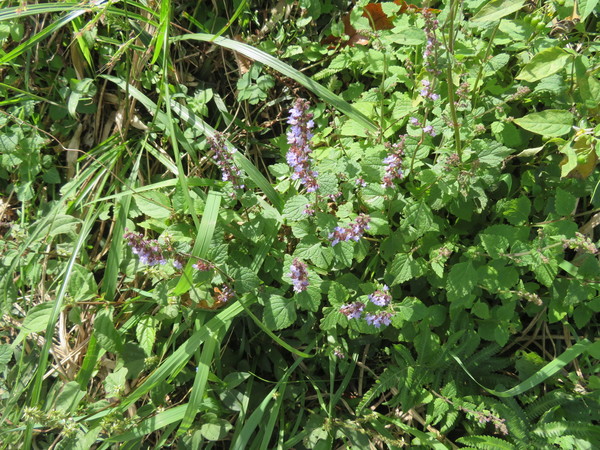
Japanese name: ヤマハッカ(山薄荷) Scientific name:Isodon inflexus
[Overview]
A perennial 40–100 cm tall, found at forest edges and similar places in the mountains.
It has underground stems.
The stem has downward-pointing hairs and is square in cross-section.
Leaves are simple and opposite, broadly ovate, 3–6 cm long and 2–4 cm wide, with sparse hairs on both surfaces.
The leaf margin has serrations.
The petiole is 0.5–3 cm long and winged.
Many cymes arise from the leaf axils and stem tips.
The flowers are blue-purple, two-lipped, 0.7–1 cm long.
The stamens and pistil are enclosed by the lower lip of the corolla.
The fruit consists of four nutlets.
[Cultivation]
Propagate by division.
It prefers a sunny to partially shaded position and fertile, well-drained soil.
For planting in the ground, it is best planted under deciduous trees.
For potted plants, from spring to autumn water thoroughly when the soil surface dries; in winter, water so that the soil does not dry out completely, or leave the pot where it will be rained on.
For plants in the ground, rainfall is sufficient.
From spring to autumn, apply slow-release fertilizer placed on the soil.
Cutting it back short in early summer produces side shoots and increases the number of flowers.
There are no particular pests or diseases.