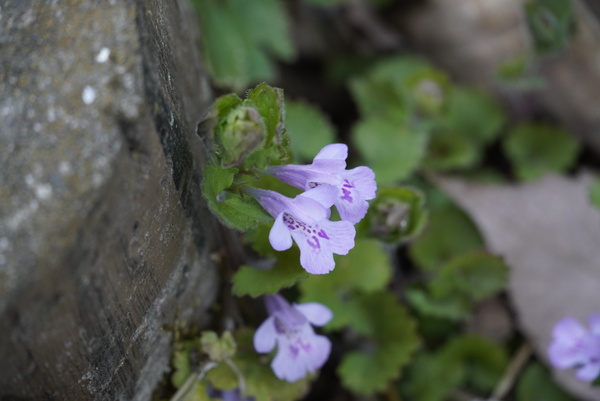
Japanese name: カキドオシ(垣通) Scientific name:Glechoma hederacea subsp. grandis
[Overview]
A perennial 5–25 cm tall, commonly seen in grassy places such as roadsides.
Crushing the stems or leaves gives off a fragrance.
The stem is at first erect, but after flowering it lies on the ground and becomes vine-like, creeping far along the ground.
Roots grow from the nodes of the stem.
Leaves are simple and opposite, round and kidney-shaped, 1–5 cm long and 1.2–5.5 cm wide, with a petiole.
The leaves are hairy and the margin has teeth.
Flowers are borne 1–3 at a time in the leaf axils.
The flowers are lipped, 15–25 mm long, pale reddish purple, with reddish purple spots on the lower lip.
The fruit is a schizocarp.
[Uses]
The whole plant is used medicinally.
[Cultivation]
Propagate by division and stem cuttings.
It is easy to grow, but care is needed because when planted in the ground it can spread too much and become a weed.
It grows in sun to partial shade and prefers fertile, moderately moist soil.
The plant weakens if it dries out.
In old plants the center may die back, so it is better to renew them by division once every few years.
For potted plants, water thoroughly when the soil surface dries.
For plants in the ground, rainfall is sufficient.
Fertilizing is not particularly necessary.
There are no particular pests or diseases.
[Notes]
The Japanese name derives from the way the stems grow long through hedges.