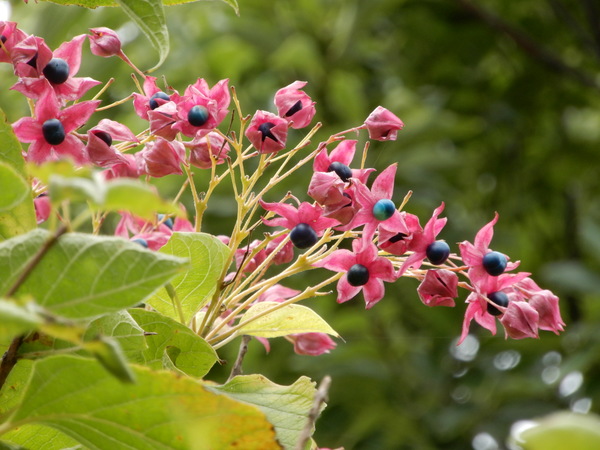
Clerodendrum trichotomum var. trichotomum(harlequin glorybower, "Kusagi")
Japanese name: クサギ(臭木) Scientific name:Clerodendrum trichotomum var. trichotomum
[Overview]
A deciduous shrub 2–3 m tall.
It is a pioneer plant: when the forest floor becomes bright through logging or the like, the seeds in the soil all germinate at once.
The bark has round lenticels.
Young branches are densely hairy.
Leaves are simple and opposite, triangular-cordate to broadly ovate, 8–15 cm long and 5–10 cm wide.
The leaf margin is entire or has small teeth, and soft hairs usually grow on the veins of the lower surface.
The petioles are long, and on the shaded side they grow longer so that the leaves reach the sun.
The leaves and branches have a distinctive smell when rubbed.
Cymes at the branch tips bear dense flowers.
The flowers are white, 2–2.5 cm across; the corolla is 5-lobed and the stamens project far out.
The calyx is pale pink.
The flowers have a sweet fragrance.
The fruit is a spherical drupe 6–7 mm across that ripens to indigo blue.
At the fruiting stage the calyx turns bright red and curls back.
[Uses]
The new shoots, young leaves and flowers are used as wild vegetables.
The fruits and calyces are used for dyeing.
[Cultivation]
Propagate from seed, cuttings or root cuttings.
It prefers a sunny, well-drained, moisture-retentive site, but is not very particular about soil.
Cultivation is easy.
[Notes]
The Japanese name comes from the distinctive smell of the leaves and branches.