
Plant Encyclopedia

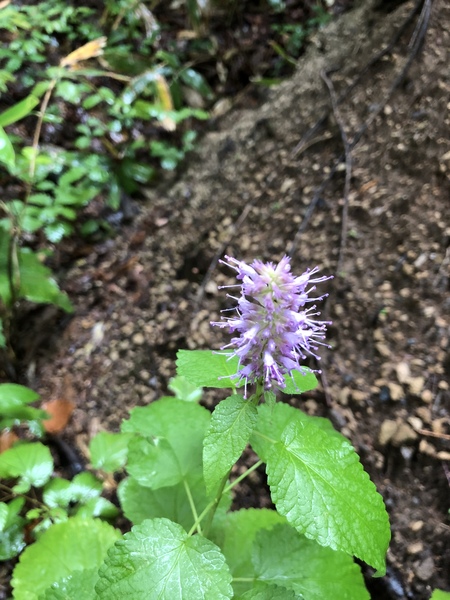
Agastache rugosa (Korean mint, "Kawamidori")
Japanese name: カワミドリ (川緑)
Scientific name: Agastache rugosa
[Overview]
A perennial growing in grasslands in the mountains.
The stem is erect, 40–100 cm tall, and branches in the upper part.
The stem is square in cross section.
The whole plant has a strong fragrance.
Leaves are simple and opposite, broadly ovate to ovate-cordate, 5–10 cm long and 3–7 cm wide.
The underside of the leaf has white hairs, and the leaf margin is serrated.
The petiole is 1–4 cm long.
A flower spike 5–15 cm long and 2 cm wide at the stem tip bears many flowers.
The bracts are small, 5–6 mm long, and covered with white hairs.
The flowers are reddish purple, lipped, and 8–10 mm long.
The upper lip of the corolla is erect, and the lower lip is 3-lobed with a broad, large central lobe.
There are 4 stamens, which project far out of the flower together with the pistil.
The calyx is tubular, 5–6 mm long, 5-lobed, and tinged with purple.
The fruit is a mericarp 1.8 mm long, obovate and flattened with three ridges.
[Uses]
The dried stems and leaves are called kakko in crude drug use, and are used to reduce fever in colds, for headache, and as an aromatic stomachic.
As a folk medicine it is also called haisoko.
Details
Japanese: カワミドリ(川緑)、キタカワミドリ(北川緑)、カッコウ(藿香)、コリアミント
Translated from our Japanese encyclopedia. If anything differs, the Japanese page is correct.