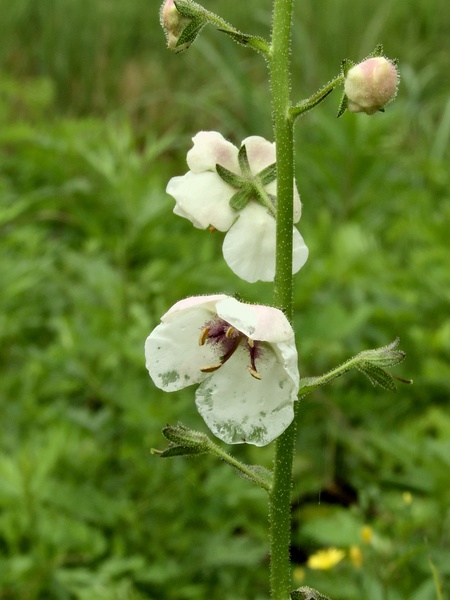
Verbascum blattaria f. erubescens("Shirobanamozuika")
Japanese name: シロバナモウズイカ(白花毛蕊花) Scientific name:Verbascum blattaria f. erubescens
[Overview]
A biennial 1.2 m tall.
The stem branches sparsely in the middle.
There are basal leaves and stem leaves; the basal leaves are elliptic, with rounded serrations or teeth on the margin, and remain at flowering time.
The leaves on the stem are simple and alternate, and their bases slightly clasp the stem.
A raceme at the stem tip bears flowers 3 cm across sparsely.
The corolla is 5-lobed and white.
There are 5 stamens, 3 of which are short, and the filaments have purple hairs.
The fruit is a flattened spherical capsule.
[History]
It was introduced in the Meiji era and has become naturalized in various places.
[Cultivation]
Propagate from seed.
It has a taproot and dislikes being transplanted, so sow directly where it is to be planted, or sow in plastic pots and then plant out.
It prefers a sunny, airy, well-drained place.
Rainfall is sufficient unless summer brings a long spell of sunny weather and the soil becomes severely dry.
Fertilizer is not particularly necessary if plenty of base fertilizer is applied.
Pests and diseases include damping-off and pyralid moths.
[Notes]
The germination longevity of the seeds is very long, and some are said to retain the ability to germinate for more than 100 years.