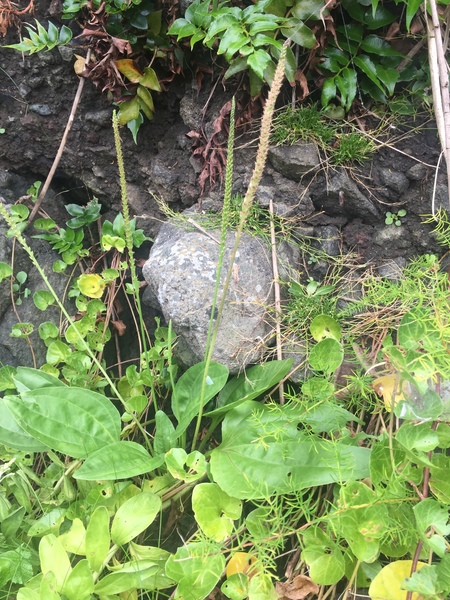
Japanese name: トウオオバコ(唐大葉子) Scientific name:Plantago japonica
[Overview]
A perennial found in damp grassland by the sea.
It has many fine roots.
The whole plant is hairless and large.
About 10–17 leaves grow from the base, ovate, rather thick, 8–25 cm long and 5–18 cm wide, with conspicuous longitudinal veins.
The leaf margins have indistinct wavy teeth.
The leaf base gradually narrows into the petiole.
A spike at the tip of a flower stalk 40–80 cm tall bears small, densely set flowers, with 4 stamens projecting far out of the flower.
The fruit is an oblong capsule, and its upper half is hemispherical.
The fruit contains 7–14 rhombic to triangular seeds.
[Uses]
The crude drug names are shazenshi and shazensou, and it is used medicinally.