
Plant Encyclopedia

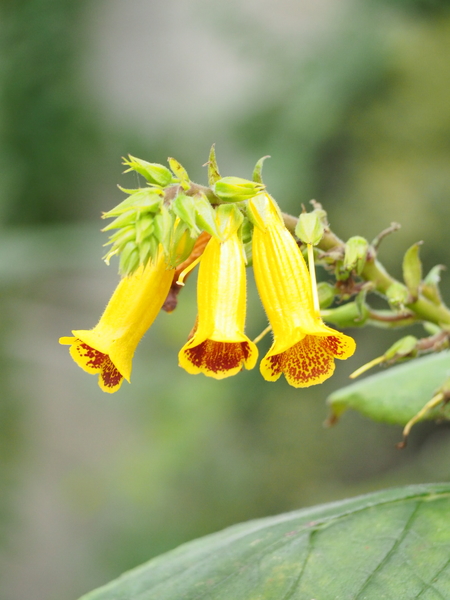
Titanotrichum oldhamii ("Matsumuraso")
Japanese name: マツムラソウ
Scientific name: Titanotrichum oldhamii
[Overview]
A perennial 15–70 cm tall, growing on moist rock faces such as along mountain streams in evergreen forests.
The whole plant is densely covered with white bristly hairs.
Leaves are simple and opposite, 5–20 cm long and 2–8 cm wide, lopsided ovate to oblong, with toothed margins.
The leaf stalk is 0.5–5 cm long.
A raceme 10–50 cm long bears flowers biased to one side.
The flowers are yellow with reddish brown spotting inside.
The flower stalk is 0.5–1.5 cm long, and the corolla is tubular, 3.5 cm long and 1.2 cm across, with the tip divided into 5 lobes in two lips.
Inflorescences arising from the leaf axils bear bulbils.
The fruit is a capsule.
[Cultivation]
Propagate from seed, by division, or by leaf cuttings.
Leaf cuttings are taken in June.
Propagation by bulbils is also possible.
A temperature of 5°C or higher is required for overwintering.
It prefers shade with high air humidity, and direct sunlight causes leaf scorch.
Also avoid strong wind.
The soil should be well drained and rich in organic matter; use hard Kanuma soil mixed with Kiryu sand, akadama soil, pumice and the like, with sphagnum moss and coconut husk chips mixed in.
Soil for alpine and wild plants may also be used.
Since it grows in places where water constantly seeps out, keep the pot standing in water or water from the bottom so that it always stays moist.
As a base fertilizer, apply a small amount of slow-release chemical fertilizer rich in phosphorus and potassium, keeping it away from the roots; in spring and autumn, give liquid fertilizer diluted 2000 times once a week to twice a month.
Remove spent flowers promptly.
There are almost no pests or diseases, but slugs may appear.
[Notes]
The name was given in memory of the botanist Ninzo Matsumura (first director of the Koishikawa Botanical Garden).
Details
Translated from our Japanese encyclopedia. If anything differs, the Japanese page is correct.