
Plant Encyclopedia

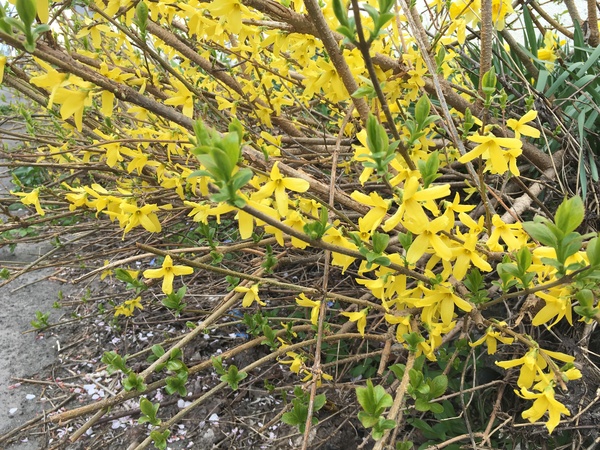
Forsythia viridissima ("Shinarengyo")
Japanese name: シナレンギョウ (志那連翹)
Scientific name: Forsythia viridissima
[Overview]
A deciduous shrub.
The new twigs are green, and the twigs have 4 ridges.
The pith is ladder-like in cross section.
Leaves are simple and opposite, oblong, 6–10 cm long and 1–3 cm wide; the upper half of the margin usually has teeth, but it may also be entire.
The petiole is 0.7–1.2 cm long.
The flowers open before or at the same time as the leaves emerge, in clusters of 1–3 in the leaf axils.
The flowers are golden yellow; the corolla is deeply divided into 4 lobes, and the lobes are oblong, 0.5 cm wide.
The fruit is a triangular broadly ovate capsule 1.5–1.7 cm long.
The seeds are about 5 mm long and have no wings.
[Uses]
The fruit is used medicinally.
[Cultivation]
Propagate by cuttings, layering, or division.
It prefers fertile, moderately moist soil with good sun, drainage and ventilation.
It dislikes strong afternoon sun.
In dry places it grows poorly and is prone to spider mites.
With poor sunlight, it flowers poorly.
For potted plants, water thoroughly when the soil surface dries, but in summer water twice, morning and evening, so that it does not run short of water.
For plants in the ground, rainfall is sufficient.
Apply organic fertilizer in winter, and slow-release fertilizer after flowering as a thank-you fertilizer.
If pruning, avoid heavy pruning after June, since the flower buds for the following year begin to form then.
Pests and diseases include powdery mildew, spider mites and scale insects.
Details
Translated from our Japanese encyclopedia. If anything differs, the Japanese page is correct.