
Plant Encyclopedia

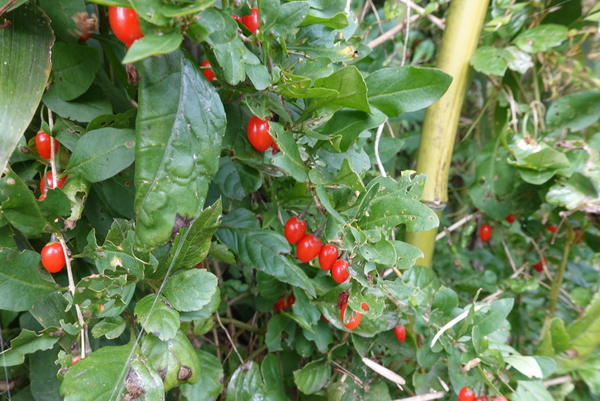
Lycium chinense (Chinese boxthorn, "Kuko")
Japanese name: クコ (枸杞)
Scientific name: Lycium chinense
[Overview]
A deciduous or semi-evergreen shrub 1–1.5 m tall, found along roadsides near houses, on waste ground, on sandy coasts, and in thickets at forest edges.
The stems branch at the base and have low ridges, and spiny short branches often arise from the leaf axils.
The leaves are simple and alternate, or clustered on the short branches; they are elliptical, 1.5–6 cm long and 0.5–2.5 cm wide, with entire margins.
The petiole is 0.2–1.5 cm.
Flowers are borne in clusters of 1–3 at the tips of short branches and are pale purple; the corolla is funnel-shaped, about 1 cm long, with 5 lobes at the tip.
The yellow anthers of the stamens are conspicuous.
The fruit is an elliptical berry 1.5 cm long that ripens red.
[Uses]
The fruit, leaves and root bark are used as crude drugs, called kukoshi, kukoyo and jikoppi respectively.
The fruit is made into fruit liquor and used in medicinal cuisine and similar dishes.
The leaves are dried and made into Kuko tea, and the young leaves are edible.
[Cultivation]
Propagate from seed or by cuttings.
It grows well in a sunny, well-drained place and is not particular about soil.
It is relatively tolerant of dryness.
For potted plants, water thoroughly when the soil surface dries.
Fertilizer is not particularly necessary, but if you want to harvest the fruit, apply organic fertilizer in winter.
Pests and diseases include powdery mildew, Tohoshi-kubiboso-hamushi, spider mites and aphids.
Details
Japanese: クコ(枸杞)、ウルフベリー、ゴジベリー
Translated from our Japanese encyclopedia. If anything differs, the Japanese page is correct.