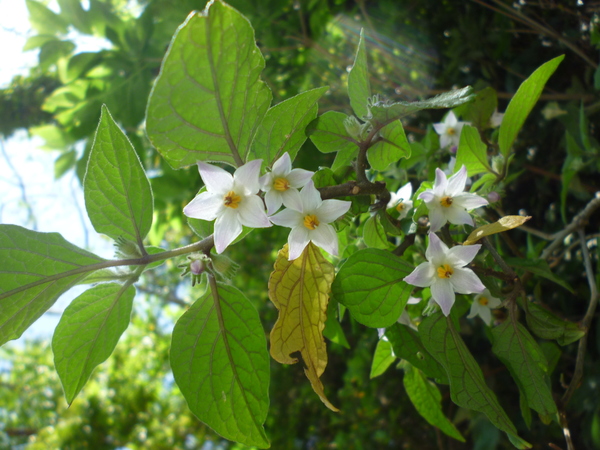
Japanese name: メジロホオズキ(目白酸漿) Scientific name:Lycianthes biflora
[Overview]
A perennial 60–90 cm tall, growing at woodland edges near the sea in warm regions.
The stem branches and is fairly densely covered with soft hairs, and the young branches are also hairy.
The amount of hair varies, and some plants are nearly hairless.
Leaves are simple and alternate, ovate to narrowly ovate, 3–6 cm long and 1.5–3.5 cm wide, with a shortly pointed tip and an entire margin.
Both surfaces of the leaves are fairly densely covered with soft hairs.
The petiole is 0.5–3 cm long.
Cymes arise from the leaf axils, each bearing 1–3 white flowers about 1 cm across.
The corolla is dish-shaped and 5-lobed.
The calyx is deeply 10-lobed, with broadly linear sepals, and, like the flower stalk, it is densely covered with pale yellowish brown hairs.
The fruit is a spherical berry 0.7–1 cm across that ripens red, with the calyx conspicuous at its base.
Sometimes there is a white dot at the tip of the fruit.