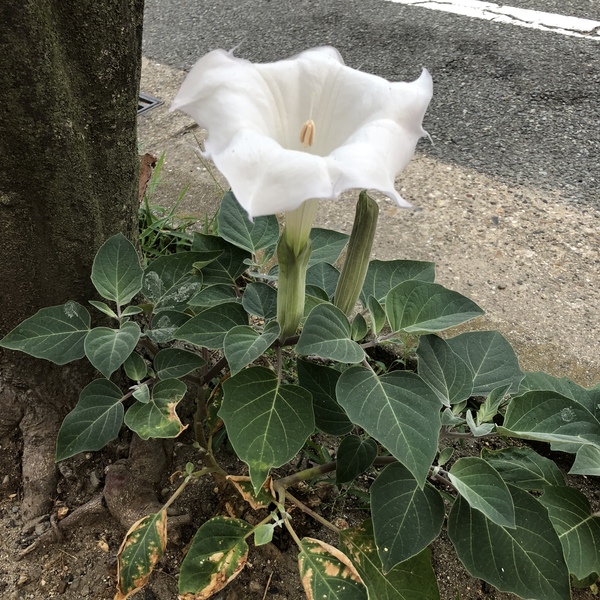
Japanese name: ケチョウセンアサガオ(毛朝鮮朝顔) Scientific name:Datura wrightii
[Overview]
A perennial 1–2 m tall.
In warm regions it becomes shrub-like.
The whole plant is densely covered with short soft hairs and looks whitish.
The new shoots, stems and leaves are sometimes tinged with purple.
The stem branches frequently.
Leaves are simple and alternate, ovate, about 8–18 cm long and 4–9 cm wide.
The leaf margin is entire or has shallow, wavy teeth.
The petiole is 2–6 cm long.
The flowers are solitary in the leaf axils or at the center of forked branches and open upward; they are white, large and trumpet-shaped, 8–10 cm across and 15–20 cm long.
The corolla margin has tail-like projections at the tips of the 5 main veins.
The calyx is tubular, 10 cm long.
The flowers have a strong fragrance when they first begin to bloom.
The fruit is a spherical capsule, borne downward, densely covered with thin spines on the surface, and it splits open when ripe.
[History]
In Japan it came to be widely cultivated after World War II, and it has become naturalized in many places.
[Uses]
The whole plant is extremely poisonous, and the seeds and dried leaves are used medicinally.