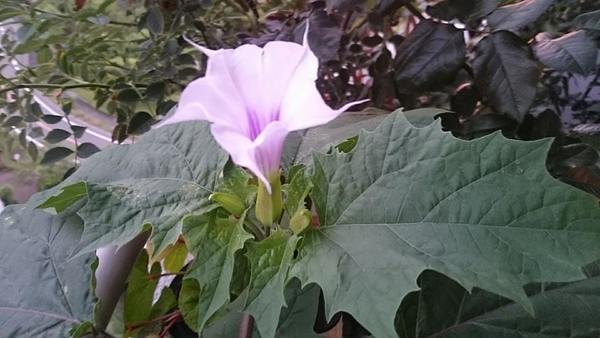
Datura stramonium f. tatura(jimsonweed, "Yoshuchosen'asagao")
Japanese name: ヨウシュチョウセンアサガオ(洋種朝鮮朝顔) Scientific name:Datura stramonium f. tatura
[Overview]
An annual 60–150 cm tall, found in fields and similar places.
It has thick roots.
The whole plant is hairless.
The stem is erect, branches frequently, and is often tinged with dark purple.
Leaves are simple and alternate, ovate, about 8–18 cm long and 4–9 cm wide.
The leaves are pointed at the tip, and the margin has irregular, large, sharply pointed teeth.
The petiole is 2–6 cm long.
The flowers are solitary in the leaf axils and open upward; they are pale purple, large and trumpet-shaped, 4 cm across and 6–10 cm long.
The tip of the corolla is 5-lobed, and the lobe tips are sharply pointed like horns.
The calyx is cylindrical with 5 ridges, 5–4 cm long.
The fruit is an ovate capsule about 3 cm long, borne upward, with thick spines on the surface, and it splits into 4 parts when ripe.
[History]
It came to Japan in the early Meiji period.
[Uses]
The whole plant is extremely poisonous, and the seeds and dried leaves are used medicinally.