
Plant Encyclopedia

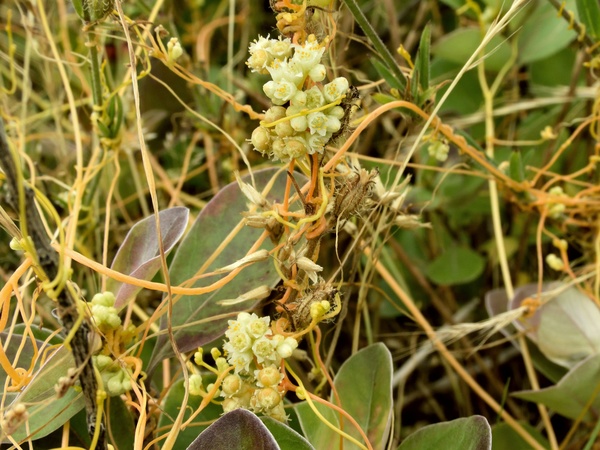
Cuscuta campestris (field dodder, "Amerikanenashikazura")
Japanese name: アメリカネナシカズラ
Scientific name: Cuscuta campestris
[Overview]
A twining annual found often on somewhat dry ground such as roadsides, wasteland and fields.
It grows in colonies, covering other plants.
It is a parasitic plant that does not choose its host, parasitizing various crops, garden plants, and native species growing on places such as sand dunes.
The stem is about 50 cm long and twines to the left; it branches, coils around other plants, and produces suckers (parasitic roots) here and there.
It has no chlorophyll and is pale yellow throughout.
The leaves are reduced, and yellowish-brown scales are attached at the nodes of the stem.
The flowers are white, about 3 mm across, and borne in short cymes arising from the axils of the scales.
The corolla is 5-lobed, and inside there are 5 scales with finely divided margins.
There are 5 stamens, which extend beyond the corolla.
The fruit is a globose capsule 2–3 mm across.
[History]
It has become naturalized worldwide.
In Japan, it was first confirmed around 1970 along the Tama River in Fuchu, Tokyo, and has since been seen almost nationwide.
[Notes]
It has been designated an Invasive Alien Species Requiring Caution under the Invasive Alien Species Act.
Details
Japanese: アメリカネナシカズラ、オオバナアメリカネナシカズラ
Translated from our Japanese encyclopedia. If anything differs, the Japanese page is correct.