
Plant Encyclopedia

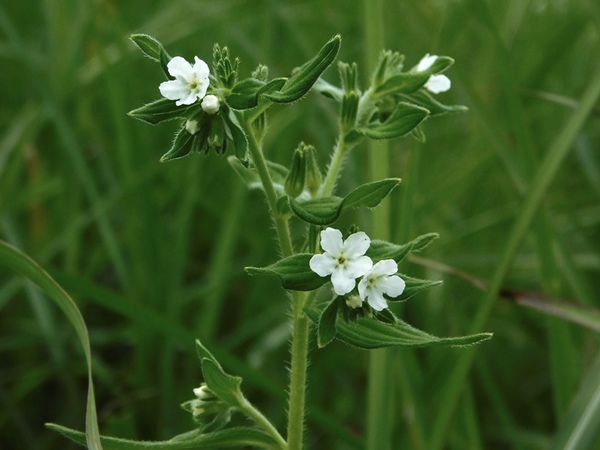
Lithospermum erythrorhizon ("Murasaki")
Japanese name: ムラサキ (紫)
Scientific name: Lithospermum erythrorhizon
[Overview]
A perennial 40–70 cm tall, growing in sunny, dry grassland.
The whole plant is covered with coarse hairs.
The root is thick and burdock-like, contains a purple pigment called shikonin, and turns purple when dried.
Leaves are simple and alternate, lanceolate, 3–7 cm long, stalkless, with the upper surface sunken along the parallel veins.
The leaf margins are entire.
The stem branches in the upper part, and white flowers 0.4 cm across bloom in the axils of leaf-like bracts.
The corolla is 5-lobed and opens flat, with projections in the throat.
The fruit is a schizocarp.
[History]
Its name appears in the Man'yoshu.
[Uses]
The root is used medicinally as purple root (shikon), and has also been used since ancient times as a dye.
[Cultivation]
Propagate from seed.
Cool regions or regions with a large day–night temperature difference are suited to planting.
It prefers sun to partial shade and deep, well-drained cultivated soil; a spot such as under deciduous trees that give partial shade in summer is suitable.
For potted plants, it is better to use a deep pot.
For potted plants, water thoroughly when the soil surface dries; for plants in the ground, rainfall is sufficient unless summer brings a long spell of sunny weather and dryness.
Pests and diseases include virus diseases, anthracnose, aphids and the leaf beetle Cryptocephalus (kisuji-minohamushi).
Details
Translated from our Japanese encyclopedia. If anything differs, the Japanese page is correct.