
Plant Encyclopedia

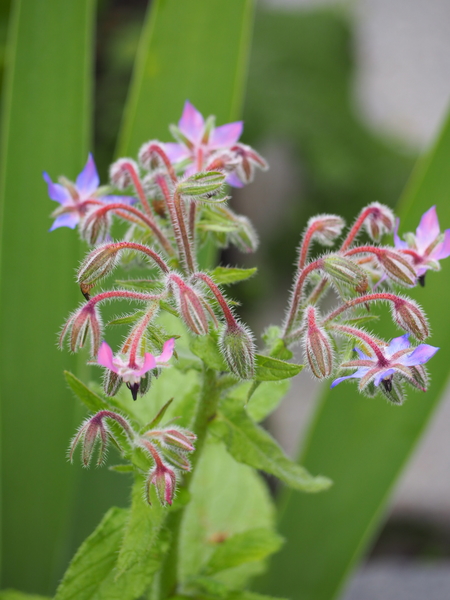
Borago officinalis (borage, "Boriji")
Japanese name: ボリジ
Scientific name: Borago officinalis
[Overview]
An annual 30–100 cm tall.
The whole plant is covered with many white stiff hairs.
The stem is hollow and branches in the upper part.
There are basal leaves and stem leaves; the basal leaves are lanceolate to ovate, 5–20 cm long and 3–8 cm wide, with long petioles.
The stem leaves are simple and alternate, with no petiole or slightly clasping the stem.
Cymes at the stem tip bear blue flowers.
Pink or white ones are also seen.
The flowers are about 2 cm across; the corolla is 5-lobed and opens in a star shape, with the lobes curving back.
The sepals are at least half as long as the petals.
The fruit consists of four black mericarps.
[Uses]
The leaves and flowers are used in cooking, and together with the seed oil it is also used medicinally.
[Cultivation]
Propagate from seed.
It has a taproot and dislikes transplanting, so sow directly where it is to grow, or sow in pots and plant out while the seedlings are young without breaking up the root ball.
It prefers sunny, well-drained, fertile soil.
It is susceptible to stuffiness in hot weather, so ensure good ventilation.
For potted plants, water thoroughly when the soil surface dries; for plants in the ground, rainfall is sufficient.
If basal fertilizer is applied, no further fertilizing is particularly necessary.
There are no particular pests or diseases.
Details
Japanese: ボリジ、ルリヂシャ(瑠璃萵苣)、ルリジサ(瑠璃萵苣)、ルリチシャ(瑠璃萵苣)
Translated from our Japanese encyclopedia. If anything differs, the Japanese page is correct.