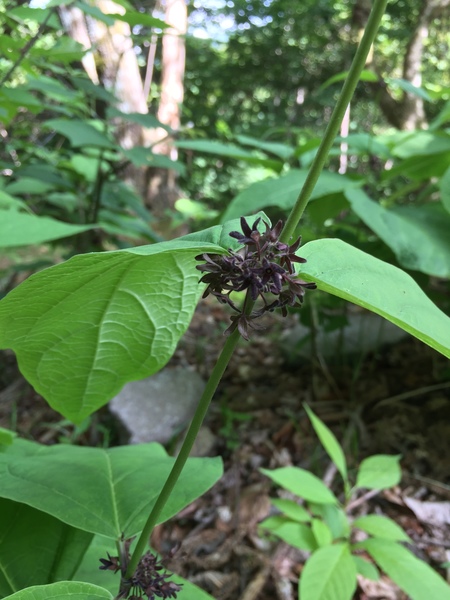
Japanese name: フナバラソウ(舟腹草) Scientific name:Vincetoxicum atratum
[Overview]
A perennial 40–80 cm tall, found in grasslands in the mountains.
The whole plant is densely covered with soft hairs.
The stem is green, erect, and almost unbranched.
Leaves are simple and opposite, ovate to elliptic, 6–14 cm long and 3–7 cm wide.
The leaf margin is entire.
The petiole is 0.8–1.2 cm.
Cymes emerge from the leaf axils and bear dense flowers.
The flowers are star-shaped, 1.5–2.5 cm across, and dark purple to yellowish brown.
The flower stalk is 0.5–1 cm long.
The fruit is a broadly lanceolate follicle 7–8 cm long, densely hairy; when ripe it splits open and releases seeds with long white hairs.
[Uses]
The root is used medicinally.
[Cultivation]
Propagate from seed.
It prefers a well-drained site in sun to partial shade.
For potted plants, water thoroughly when the soil surface dries; for plants in the ground, rainfall is sufficient unless sunny weather continues and the soil becomes dry.
In spring, apply slow-release fertilizer placed on the soil.
There are no particular pests or diseases.
[Notes]
The name is said to compare the shape of the split fruit halves to the belly of a boat.