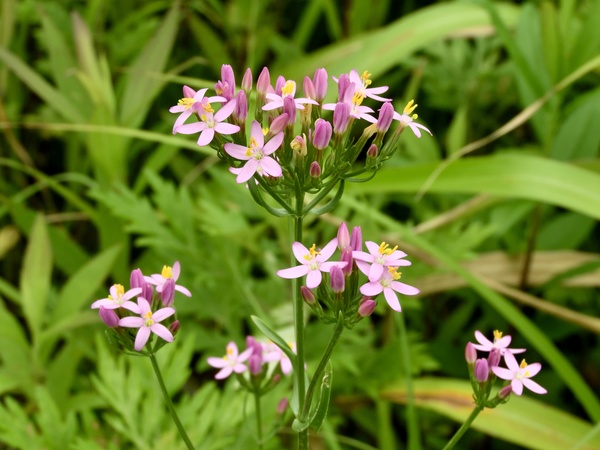
Japanese name: ベニバナセンブリ Scientific name:Centaurium erythraea
[Overview]
A biennial about 60 cm tall, found in vacant lots and similar places.
The stem is hollow with 4 ridges and branches in the upper part.
There are both basal leaves and stem leaves; the basal leaves are oblong to spatulate, usually form a rosette, and remain at flowering time.
The leaves on the stem are simple, opposite and entire, with the base slightly clasping the stem.
The flowers are borne in dense cymes at the stem tips, about 1 cm across, and pale pink or white.
The corolla is 5-lobed, and the calyx lobes are about 1/3 the length of the flower tube.
There are 5 stamens, protruding from the corolla.
The anthers are yellow, surround the style, and twist strongly when they split open.
The stigma of the pistil is divided in two, but before maturity the two parts are held together facing inward.
The fruit is a capsule.
[History]
It is said to have been introduced as a horticultural plant in the Taisho era.