
Plant Encyclopedia

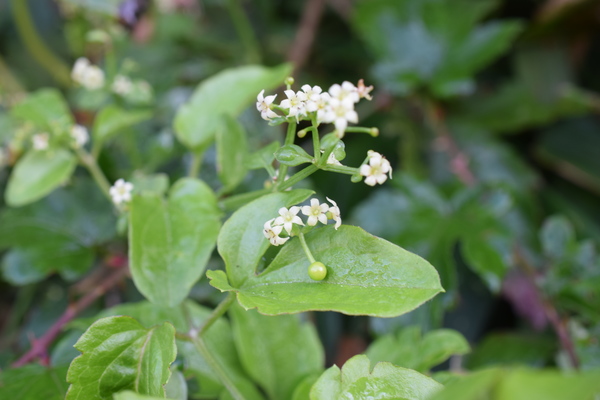
Rubia argyi ("Akane")
Japanese name: アカネ (茜)
Scientific name: Rubia argyi
[Overview]
A climbing perennial growing near houses and at the edges of woods in hills and fields.
It has thin, branching rhizomes, and the roots are yellowish brown but turn red when dry.
The stems branch freely and have 4 ridges, with small downward-pointing prickles on the ridges.
The leaves are in whorls of 4, triangular-ovate to ovate, 3–7 cm long and 1–3 cm wide, with a pointed tip, a heart-shaped base and entire margins.
Of the leaves in a whorl, the true leaves are the 2 that are opposite, and the others are stipules of the same shape.
The upper leaf surface is densely covered with short stiff hairs, and the veins on the underside have small downward-pointing prickles.
The petiole is 0.5–4.5 cm long and has small downward-pointing prickles.
Cymes emerge from the leaf axils, and the inflorescence has small downward-pointing prickles.
The flowers are about 0.3–0.4 cm across and yellowish green, and the corolla is 5-lobed.
The fruit is a spherical berry that turns black when ripe.
[Uses]
It is used as a scarlet dye (akane dyeing) and for medicinal purposes.
[Cultivation]
Propagate from seed or by division.
It prefers a sunny to partially shaded site with good drainage and good moisture retention.
It is hardy, grows densely, and is easy to cultivate.
Take care not to let it run out of water; for potted plants, water thoroughly when the soil surface dries, and for plants in the ground, rainfall is sufficient unless sunny weather continues and the soil dries out.
Fertilizer is not particularly necessary if a base fertilizer is applied.
There are no particular pests or diseases.
[Notes]
The Japanese name comes from the color of the dried root.
In the Man'yoshu it appears in the makurakotoba (fixed poetic epithet) "akane-sasu."
Details
Translated from our Japanese encyclopedia. If anything differs, the Japanese page is correct.