
Plant Encyclopedia

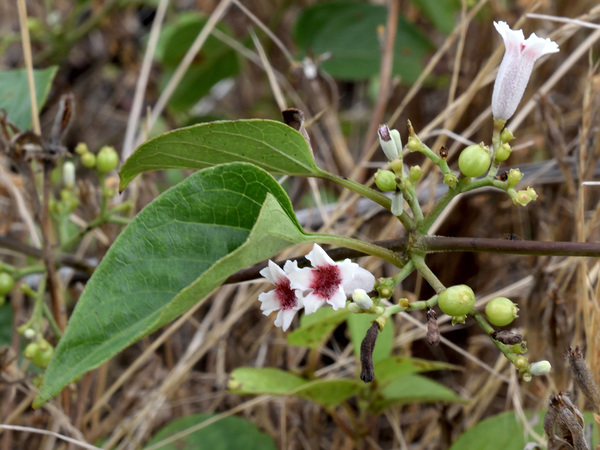
Paederia foetida (skunkvine, "Hekusokazura")
Japanese name: ヘクソカズラ (屁糞葛)
Scientific name: Paederia foetida
[Overview]
A climbing perennial commonly seen along sunny roadsides and in grasslands.
The whole plant has a distinctive smell.
The vine twines to the left (counterclockwise seen from above), climbing by winding around other objects, and the base becomes woody.
Leaves are simple and opposite, lanceolate to ovate, 4–10 cm long and 1–7 cm wide, with a heart-shaped base.
The leaf margin is entire.
There is a leaf stalk.
The inflorescences arising from the leaf axils branch freely and bear several to several dozen flowers.
The flowers are funnel-shaped with a shallowly 5-lobed tip, white to pale pink, and the inside is reddish purple and densely covered with glandular hairs.
The fruit is a spherical drupe that ripens yellowish brown.
[Uses]
The fruit is used externally as a folk remedy for chilblains and chapped skin.
[Notes]
The alternative Japanese name Yaito-bana compares the red center of the flower to the mark left by moxa cautery (yaito).
Plants that grow on the seashore and have hairless, glossy leaves are sometimes distinguished as Hama-saotome-kazura, those with long corollas as Tsutsunaga-yaito-bana, and those with many hairs on the leaves as Birodo-yaito-bana.
Details
Japanese: ヘクソカズラ(屁糞葛)、ヤイトバナ(灸花)、サオトメカズラ(早乙女葛)、ハマサオトメカズラ(浜早乙女葛)、アケボノヤイトバナ(曙灸花)、ビロードヤイトバナ、サメハダヘクソカズラ、ツツナガヤイトバナ
Translated from our Japanese encyclopedia. If anything differs, the Japanese page is correct.